Sneaker raffles and limited drops: how to win
Sneaker raffles are not rigged. See the probability math behind entering many limited drops, plus the SKU and monitor intel that raises your real hit rate.
Turn this into live alerts.
Use the Divine Pro free trial to see sneaker, retail, card, price-error, and autocheckout alerts before you pay.
Start Divine Pro free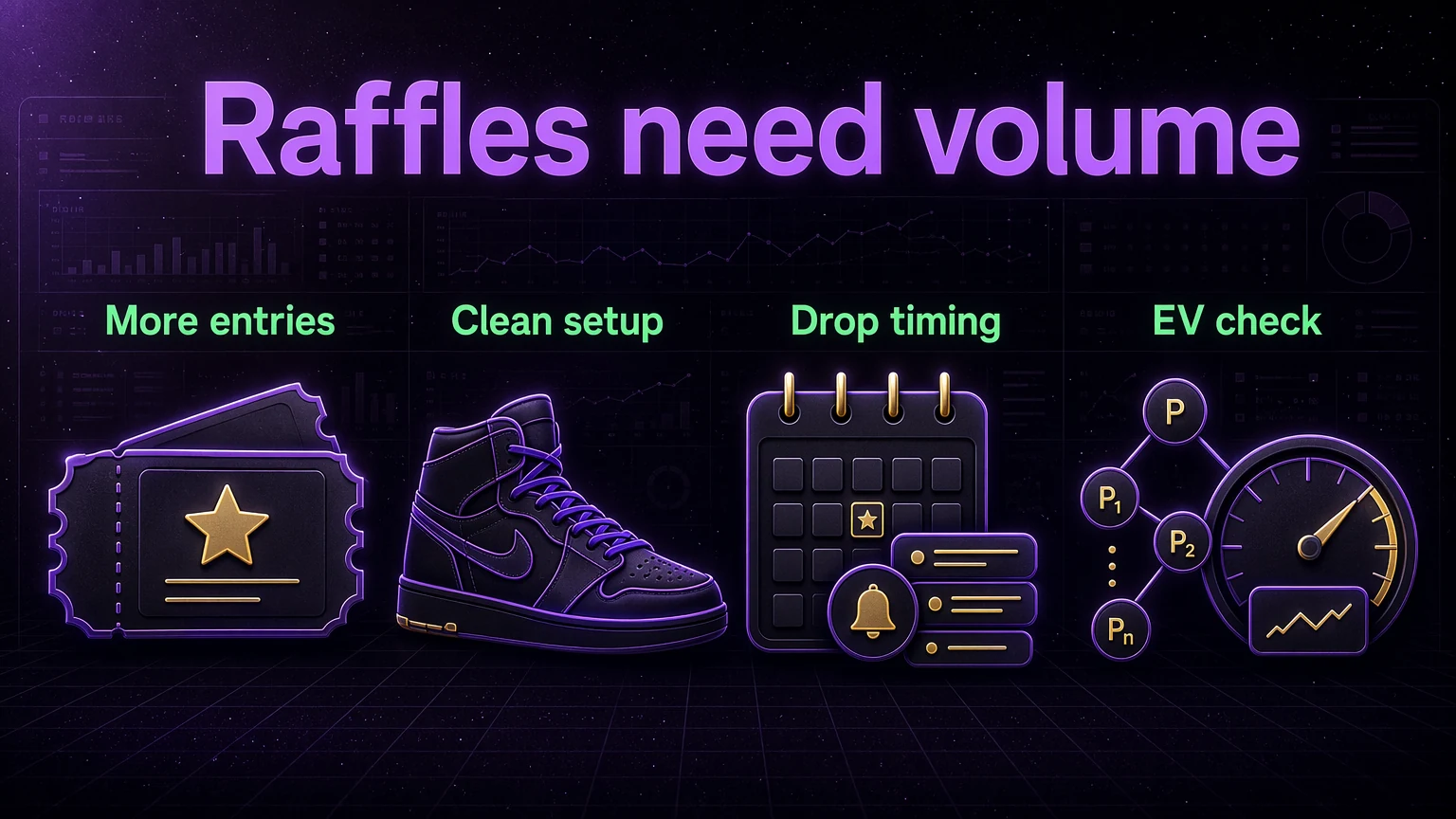
You set an alarm. You cleared your morning. You loaded SNKRS the second the pair went live, tapped enter, and stared at your phone for an hour. Then the notification came: not this time. Same for the shop raffle. Same for the boutique in the next city. Three losses before breakfast, and somewhere a reseller you have never met just walked away with the exact pair you wanted.
So you tell yourself the thing everyone tells themselves. The raffles are rigged. The bots got them all. Regular people never win.
That belief is the most expensive one in sneakers, because it makes you stop entering. And the only guaranteed way to win zero pairs is to enter one raffle, lose, and quit.
Here is the truth the losing streak hides. A single hyped raffle really does give you a tiny chance. That part is not paranoia, it is math. But the outcome you actually control is not one raffle. It is how many raffles you enter, how fast you find them, and whether you already know the SKU, the retailers, and the resale comp before the window opens. Stack enough clean entries and the "impossible" pair becomes a coin you flip often enough to land. Let's do the numbers.
The lie: "raffles are rigged"
When people say rigged, they usually mean one of three things. Insiders get the pairs first. Bots vacuum the stock. The draw is fake and winners are pre-chosen. Let's take those seriously instead of dismissing them, because the real picture is more useful than the myth.
Major brand draws are random by design, and the brands say so plainly. Nike's own help pages describe SNKRS draws as randomized selections meant to give members a fair shot, and they cap you at one entry per person per launch pair. adidas describes CONFIRMED draws the same way: winners selected at random, and being first to enter does not change your odds. That last point matters because it kills a myth in the other direction too. On a true draw, speed inside the window buys you nothing. You either got a valid entry in before the window closed, or you did not.
There are two honest wrinkles.
First, some drops are not draws at all. adidas CONFIRMED runs three formats: draw (random), queue (first come, first served while stock lasts), and invite (members only). Nike runs LEO releases (Limited Entry Opportunity, no countdown, a short two to three minute window) and DAN releases (Draw And Notify, a longer ten to thirty minute window with winners drawn after it closes). On a queue or a LEO, timing and readiness genuinely help. On a draw, they do not. Knowing which format you are in tells you whether to sprint or to relax.
Second, brands reward loyalty on the hottest collaborations. Nike has publicly described skewing invites toward members who entered and lost before. In one widely reported example around an Off-White Dunk release, about 90 percent of invites went to members who had missed a prior Off-White collaboration over the previous two years. Read that again, because it flips the whole "rigged against me" story. Losing is not a dead end on those releases. It is how you build the record that gets you picked next time. The people who quit after three losses opt themselves out of the exact system that was starting to favor them.
So no, the draw is not fake. It is a lottery with disclosed rules and a loyalty layer on top. The villain is not a rigged machine. The villain is entering once, losing, and believing the machine cheated you.
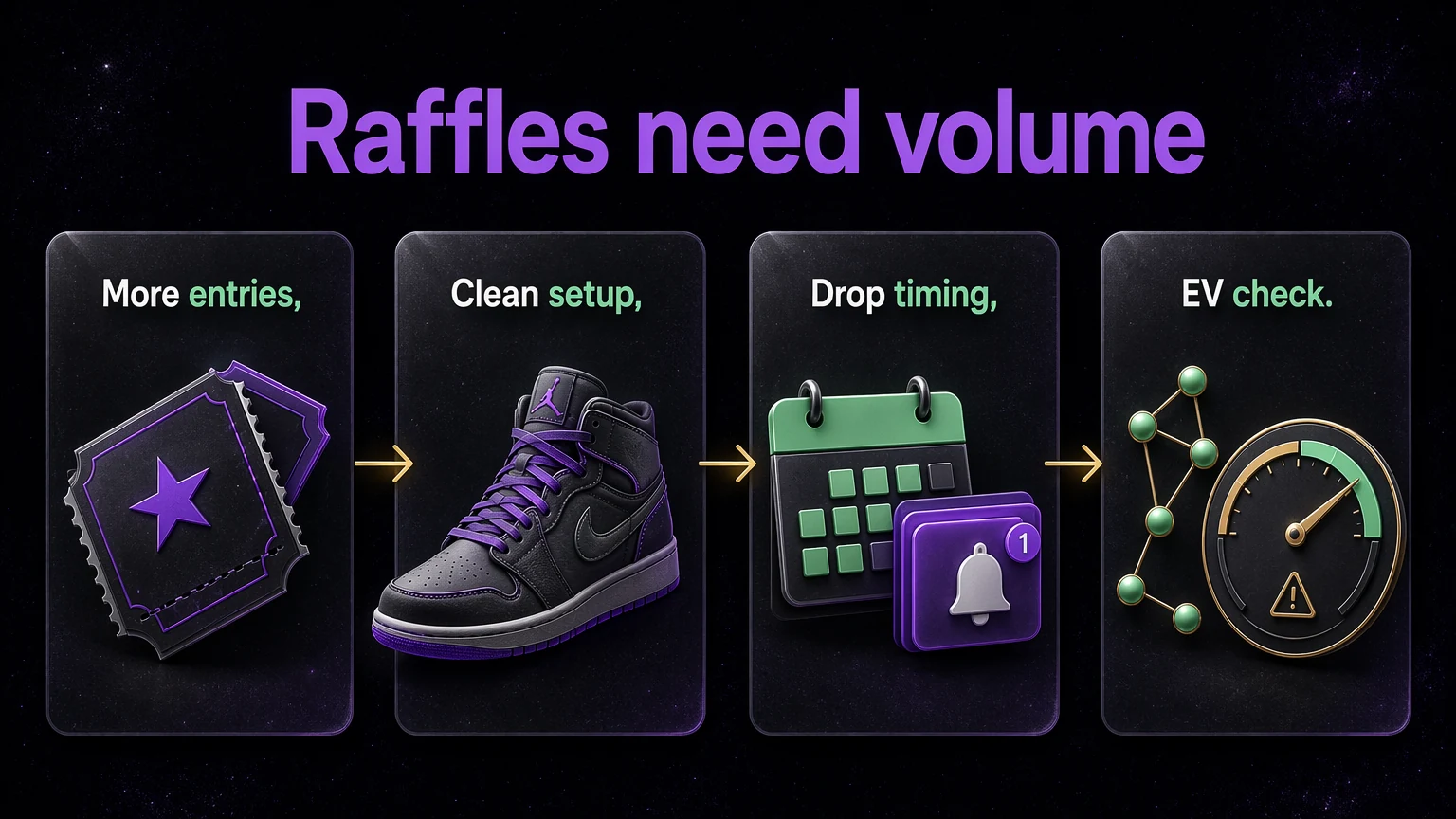
The fix: play volume, and play it with intel
If one raffle is a lottery ticket, the move is obvious and boring: hold more tickets. But there are two ways to hold more tickets, and only one of them is safe.
The wrong way is stacking many fake entries into a single raffle. Ten accounts on one SNKRS drop, a proxy farm, a bot on one boutique. Brands filter this aggressively now, and the penalty is not a warning. It is cancelled entries and banned accounts, which destroys the loyalty record you need for the good drops. You are torching your future odds to juice one raffle. Do not.
The right way is entering many different raffles for the same pair, each one legitimately, once. A hyped shoe does not release in one place. It goes up on the brand app, on the brand's own site, and across a spread of retailers and boutiques that each run their own separate raffle for their own allocation. Each of those is an independent draw with its own random selection. Enter twenty of them cleanly and you are not cheating any single raffle. You are simply present in twenty different lotteries for the same shoe.
This is where intel turns a hobby into a system, and where a reselling community earns its keep. To enter twenty raffles for one pair, you first have to know all twenty exist, know the style code so you are entering the right shoe, and catch each short window before it shuts. That is not something you do by refreshing Instagram. It is what SKU tracking and stock monitors are built for, and it is a core reason people pay for release alerts instead of going it alone. A monitor watching the SKU across retailers can surface every raffle link the moment it opens, which is the difference between entering three raffles and entering twenty five. More on the tooling in how monitors and alerts work.
Volume plus intel. That is the whole fix. Now the number.
The number: expected value across N raffle entries
Here is the part the "it's rigged" crowd never runs, and it is the part that changes behavior.
Say a given raffle gives you a 2 percent chance to win. That is a fair rough figure for a hyped pair with far more entrants than stock. Enter one raffle and yes, you almost certainly lose. But the raffles are independent, so the chance you lose all of them multiplies. Your chance of winning at least one pair across N raffles is:
P(at least one win) = 1 minus (1 minus p) to the power N
With p at 2 percent, that formula does something the doom story hides:
| Raffles entered (N) | Chance of at least one win | Expected wins (N x p) |
|---|---|---|
| 1 | 2.0% | 0.02 |
| 5 | 9.6% | 0.10 |
| 10 | 18.3% | 0.20 |
| 20 | 33.2% | 0.40 |
| 30 | 45.5% | 0.60 |
| 40 | 55.4% | 0.80 |
| 50 | 63.6% | 1.00 |
Enter one raffle: a rounding error. Enter forty: better than a coin flip that you walk away with the pair. The shoe did not get easier. You stopped betting your whole outcome on a single ticket. This is why the person who "always wins raffles" is almost never lucky. They are entering ten to fifty windows per hyped release while you enter three.
Now attach dollars, because a chance to win is only worth what the win pays.
Take a realistic hyped pair. Retail 180 dollars. Current resale comp around 320 dollars. Note that resale is a moving target, so this is illustrative, not a promise. Always pull a live comp before you get attached to a number.
If you win and sell on StockX at entry-level seller fees (roughly a 9.5 percent transaction fee plus about 3 percent payment processing, so about 12.5 percent all in) plus roughly 5 dollars to ship to authentication:
- Sale price: 320
- StockX fees at about 12.5 percent: about 40
- Shipping to authentication: about 5
- Payout: about 275
- Minus retail cost: 180
- Net profit per winning pair: about 95 dollars
Sell the same pair on eBay instead, where authenticated athletic shoes over 150 dollars carry a lower final value fee (around 8 percent for non-store sellers) plus a small per-order fee, and eBay's Authenticity Guarantee is free to the seller on eligible sneakers over 100 dollars:
- Sale price: 320
- eBay fee at about 8 percent plus about 0.40: about 26
- Minus retail cost: 180
- Net profit per winning pair: about 114 dollars (before your outbound shipping and any promoted-listing spend)
Fees are not a footnote, they are the difference between a 95 dollar flip and a 114 dollar flip on the same shoe, which is why platform choice matters. The full breakdown of what marketplaces skim lives in reselling profit margins explained. Use the conservative 95 dollars for the expected value math so you are never disappointed.
Expected value of a single raffle entry = p x profit per win.
At 2 percent and 95 dollars, each clean entry is worth about 1.90 dollars in expected value. That sounds small until you remember entries cost you no money up front on a draw. You only pay if you win. The cost is time, roughly a couple of minutes per entry once your profile, size, and payment are saved.
So run the full picture across 40 entries on one release:
- Expected wins: 0.8 pairs
- Expected gross profit: 0.8 x 95, about 76 dollars
- Time spent: 40 entries at about 2 minutes each, plus setup, call it a bit under 2 hours
- Chance you walk away with nothing: about 45 percent
- Chance you win two or more pairs on this one release: about 19 percent
Sit with those last two lines, because they are the honest ones. Nearly half the time, forty entries still nets you zero on a single release, and that is not the system cheating you, that is variance. The math only pays out over many releases. Enter forty raffles across ten hyped releases through a season and your expected wins climb toward eight pairs, and the odds of a long shutout shrink fast. One release is a gamble. A season of disciplined entries is a strategy. That distinction is the entire game.
Two levers move that expected value, and both are inside your control. Raise p (better targeting, loyalty on brand apps, prioritizing local and boutique raffles where crowds are smaller and your odds per raffle are genuinely higher). Raise N (catch more windows, which is a pure intel and speed problem). Neither lever requires a bot. Both reward a reseller who shows up with information instead of hope.
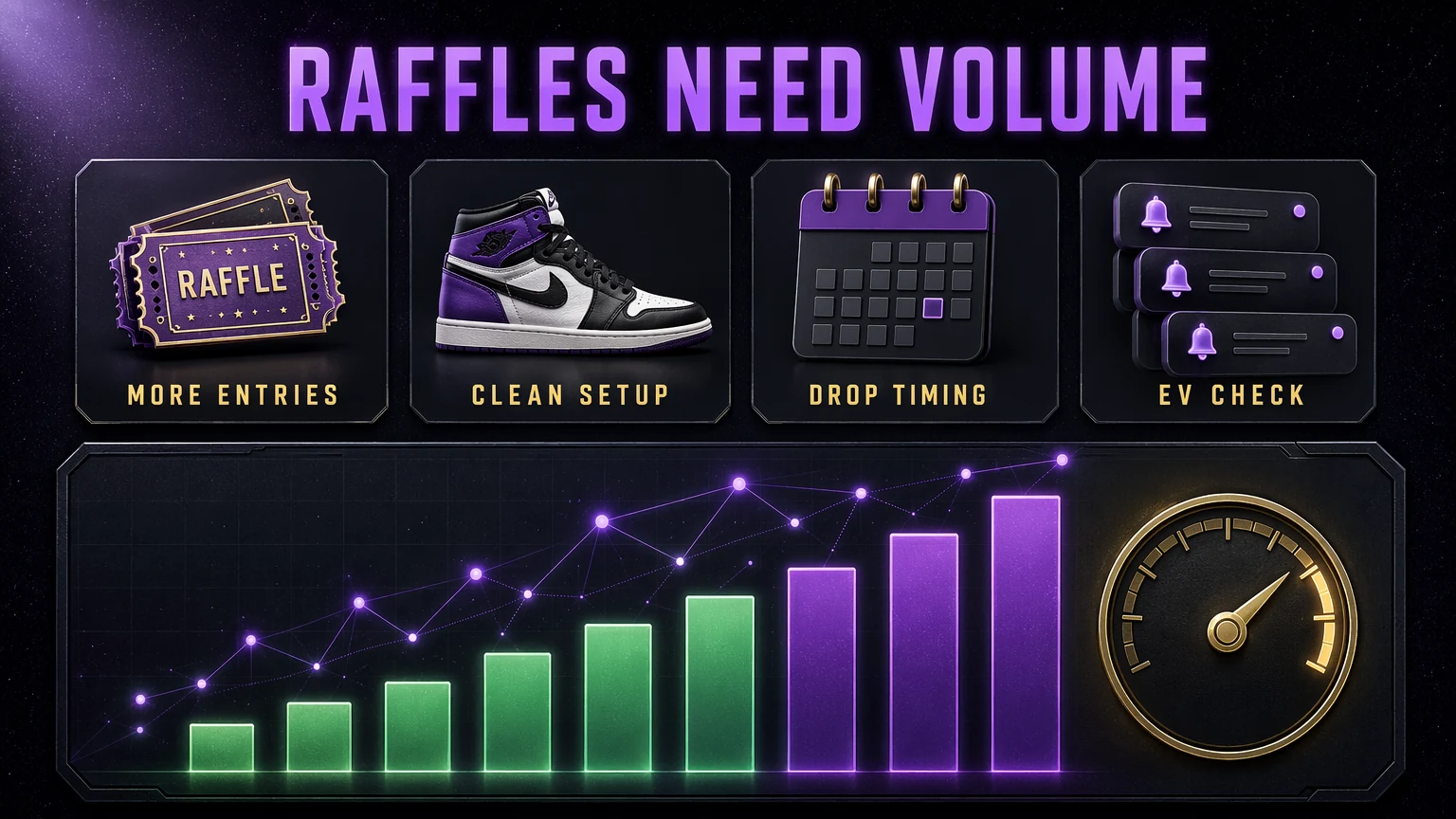
A repeatable pre-drop routine
Winning raffles is a process you run the same way every time, not a mood you get into on drop day. Here is the loop.
Days before the drop
Lock the SKU. Every hyped shoe has a style code, and that code is how you tell the real pair from lookalikes and how a monitor tracks it across sites. Know it. Then map the raffle field: brand app, brand site, and the list of retailers and boutiques that will each run a separate raffle. This map is the single biggest driver of your N, and it is exactly the kind of list a release-alert community assembles for you so you are not rebuilding it every week.
Set up your accounts once
Create real accounts at the retailers you will enter. Fill in profile, verified phone, email, size, shipping, and payment on each, in advance. Half of all raffle losses that feel like bad luck are actually a checkout that timed out because a card was not saved. On the brand apps, keep entering even the pairs you lose, because that participation is what feeds the loyalty selection on the drops you really want.
The morning of
Know your format per retailer. Draw means enter once and wait, speed does not help. Queue or LEO means be ready the second it opens because it is first come, first served or a very short window. Turn on notifications so you catch every opening, and work your mapped list top to bottom. Enter each raffle once, correctly, at the right size. Never stack fake entries into one raffle. That is the line between playing volume and getting banned.
After results
Log what you won, what you lost, and where. Over a season this tells you which retailers and which pair types actually convert for you, so you can pour more entries into the raffles with real odds and stop wasting mornings on the ones that never hit. On the brand apps, your losses are quietly building the record that improves your future odds. Keep going.
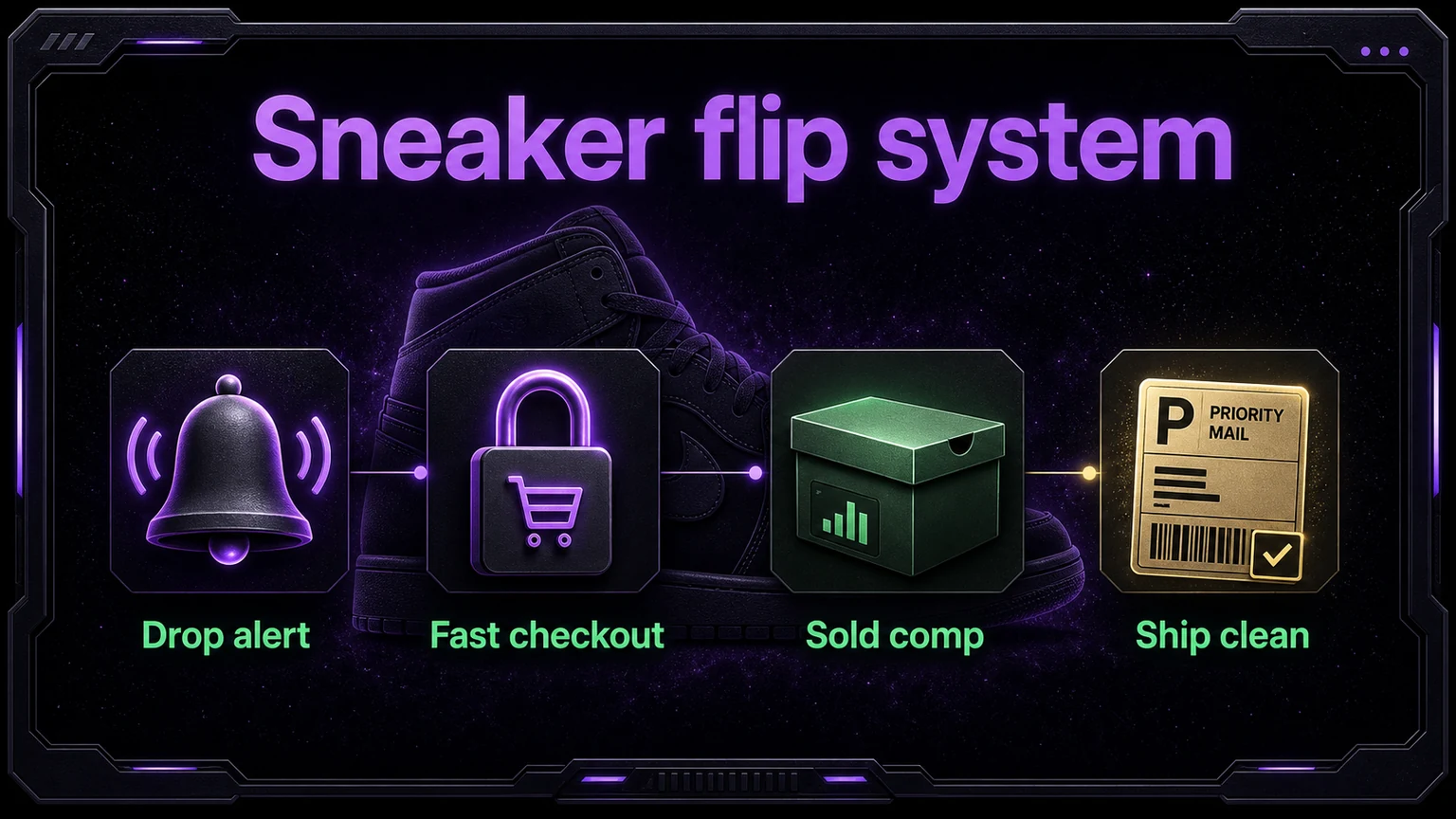
If you would rather not build the SKU map, the retailer list, and the monitor coverage yourself every single week, that is the specific work a reselling community does for its members. Join Divine on Whop for release alerts, SKU tracking, and the free autocheckout tool that helps you clear the queue and LEO drops where speed actually counts.
What a win is really worth: the full flip math
The raffle is only half the play. Winning the entry means you earned the right to buy at retail. The profit shows up when you sell, and only after fees. Here is the same pair, fully costed, so nobody mistakes resale price for profit.
| Line item | StockX | eBay (Authenticity Guarantee) |
|---|---|---|
| Resale comp | 320 | 320 |
| Retail cost (your buy) | 180 | 180 |
| Marketplace fee | about 40 (about 12.5%) | about 26 (about 8% plus 0.40) |
| Shipping | about 5 to authentication | outbound label cost |
| Net profit per pair | about 95 | about 114 |
| ROI on 180 cost | about 53% | about 63% |
Two honest notes on that table. Resale comps move, sometimes down hard once a pair restocks or the hype cools, so a shoe that comps 320 today can comp 220 in a month. And ROI percentages look thrilling until you remember most raffles you enter, you lose, so your real return is that per-pair profit multiplied by your actual hit rate, not by every entry. The margin is real. It is just not automatic, and it is not the sticker resale price. For the wider view of which drops carry margin worth chasing, see how to flip sneakers for profit.
Where the real money leaks
The raffle you lost is not what is costing you. These are.
Paying resale to a scalper for a pair you could have raffled. The whole point of entering forty raffles is to buy at 180 instead of paying someone else 320. Every time you cave and buy resale on a pair you could have won at retail, you hand your entire margin to the person who did the entering. Losing patience is more expensive than losing a raffle.
Entering three raffles and calling it a day. Look back at the table. Three entries at 2 percent is a 6 percent shot. That is not the raffle being rigged. That is you buying almost no tickets and blaming the lottery.
Missing windows you could have caught. A boutique raffle open for four hours that you found six hours late is a pair you never entered. Speed to information is the cheapest edge in this whole game, and it is exactly what monitors and alerts exist to buy back. Related: how to spot price errors runs on the same instinct, catching the opening before the crowd does.
Chasing hype that is about to crash. Not every limited pair holds resale. Some flood the market on restock and comp below retail within weeks. Winning the raffle for a pair that comps under your cost is a loss with extra steps. Check the comp before you get emotionally attached to the shoe.
Who should skip this
This is not for everyone, and pretending otherwise would be a lie.
Skip the raffle grind if you want one specific pair in one specific size and nothing else will do. The math only works across volume, and volume means entering pairs you are willing to flip, not only the one shoe of your dreams. If you cannot stomach entering forty times to maybe win once, or winning zero across a whole release and shrugging it off, the variance will wear you down. This rewards patience and detachment, not desire.
Skip it if you will not do the boring setup. Accounts, saved payment, SKU tracking, and a retailer map are the actual work. Without them you are back to three entries and a prayer.
And skip the shortcut merchants entirely. Anyone selling you a bot farm and a promise that you "can't lose" is selling a ban and a myth. Brands filter fake entries, and the penalty falls on your accounts, not theirs. The honest edge is legitimate volume plus better information, full stop. If a service will not show you the mechanism, walk. How to avoid reselling scams covers the tells.
FAQ
Are sneaker raffles actually rigged?
No. Major brand draws are described by the brands themselves as random selections, capped at one legitimate entry per person, with winners chosen at random. What feels like rigging is usually just low per-raffle odds combined with entering too few raffles. The one honest twist is that some brands, Nike among them, reward loyalty on their hottest collaborations by favoring members who entered and lost before. That is a reason to keep entering, not a reason to quit.
How many raffles should I enter to have a real shot?
At a rough 2 percent per raffle, one entry is about 2 percent, twenty entries push you past 33 percent, and forty entries put you above a coin flip for at least one win on a release. There is no fixed magic number. The rule is simple: your realistic odds scale with how many separate, legitimate raffles you catch and enter for the same pair. Volume is the lever you control.
Is it against the rules to enter the same shoe at multiple stores?
Entering different retailers' separate raffles for the same pair is normal and expected, because each store runs its own independent draw for its own stock. What gets you banned is stacking multiple fake entries into a single raffle, using bot farms or proxies to fake many accounts on one drop. One clean entry per raffle, across many raffles, is the safe and effective approach.
Does entering a raffle faster improve my odds?
On a true draw, no. adidas and Nike both indicate that on random draws, being first to enter does not change your chance of winning, you only need a valid entry before the window closes. But format matters: a queue or a first-come release rewards speed and readiness, so know whether the drop is a draw or a queue before you decide to sprint. That is where saved payment details and a fast checkout tool earn their place.
What does it actually cost to enter raffles?
On draw-style raffles, nothing up front. You only pay if you win, so the real cost is your time, roughly a couple of minutes per entry once your accounts and payment are saved. The bigger hidden cost is missing raffles you never knew about, which is why resellers pay for alerts and SKU monitors: the tooling raises your entry count, and entry count is what raises your odds.
If I win, where should I sell for the best margin?
It depends on the pair and your patience. For authenticated athletic shoes over 150 dollars, eBay's sneaker fee runs lower (around 8 percent for non-store sellers) with free authentication on eligible pairs, which often nets more per flip. StockX bundles authentication and pays faster but takes more all in (roughly 12.5 percent at entry-level seller tiers). Many resellers use both and route each pair to wherever it nets more after fees. Run the numbers per sale, never assume.
Verdict
Raffles are not rigged. They are lotteries with disclosed odds and a loyalty layer, and the outcome you control is not any single draw, it is how many clean entries you place and how fast you find them. One entry is a rounding error. Forty entries on a season of releases is a real, repeatable edge with real per-pair margin behind it. The people who win consistently are not luckier than you. They know the SKU, they have the retailer map, they catch every window, and they never quit after three losses.
Your next move is to raise two numbers: p, by targeting the right raffles and building loyalty on the brand apps, and N, by catching more windows than you can find alone. That second number is where release alerts, SKU tracking, and autocheckout tools do the heavy lifting. Join Divine on Whop to get the drop map, the monitors, and the free checkout tool built for exactly this, and there is a 5-day free trial so you can test the alerts on the next drop before you commit.
Realistic expectations: reselling sneakers is a business with real costs and real risk. Marketplace fees, shipping, taxes, unsold inventory, and time all eat into profit, resale comps move and can fall below your cost, and no raffle strategy guarantees a win or a profit. The math here is illustrative, not a promise. Pull your own live comps, enter within each retailer's rules, and treat every flip as a bet with an expected value, not a sure thing.
Get to the deal first
Divine is the alert network, monitors, and autocheckout built on this exact process. Try Divine Pro free for 5 days.
Reselling is a real business with real costs: marketplace fees, shipping, taxes, and unsold inventory. Profits are never guaranteed. Always check the comps before you buy.