Reselling profit margins: what a $200 flip pays
Reselling profit margins with real fee math: what a $200 sale pays after eBay fees, shipping, taxes, net margin, and ROI.
Turn this into live alerts.
Use the Divine Pro free trial to see sneaker, retail, card, price-error, and autocheckout alerts before you pay.
Start Divine Pro free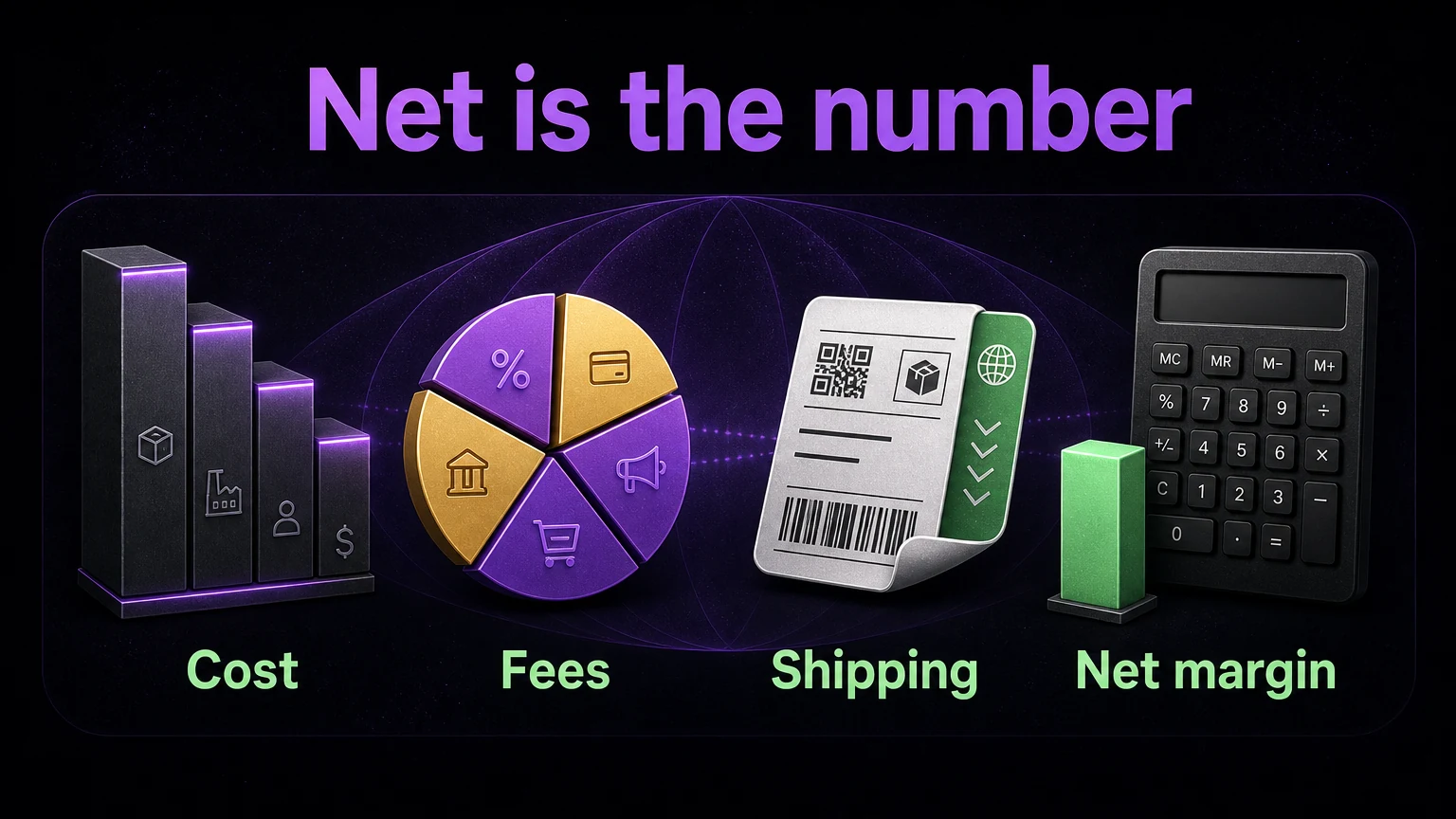
You sold it for $200. You paid $110. So you made $90, right?
Wrong. And that gap is where most resellers quietly bleed out.
You watched the sale notification hit. You felt the dopamine. You did the easy subtraction in your head, $200 minus $110, and you told yourself the flip cleared $90. Then the payout landed and it was $173.20, not $200. Then you remembered the $12 shipping label. And the $2 in packaging. And that you still owe income tax on the profit at the end of the year. The $90 win you celebrated was actually closer to $49. You made money, but you made a little over half of what you thought.
Sale price is not profit. Sale price is the number the villain wants you to fixate on so you keep buying things that never really cleared margin. This post fixes that, permanently, with the real math.
The one lie that quietly kills your margin
The lie is short: "sale price is profit."
It survives because subtraction feels like accounting. You buy at $110, you sell at $200, you subtract, you get $90, and the brain files it as done. That $90 becomes the story you tell yourself about the flip. It becomes the number you use to decide whether the next deal is "worth it."
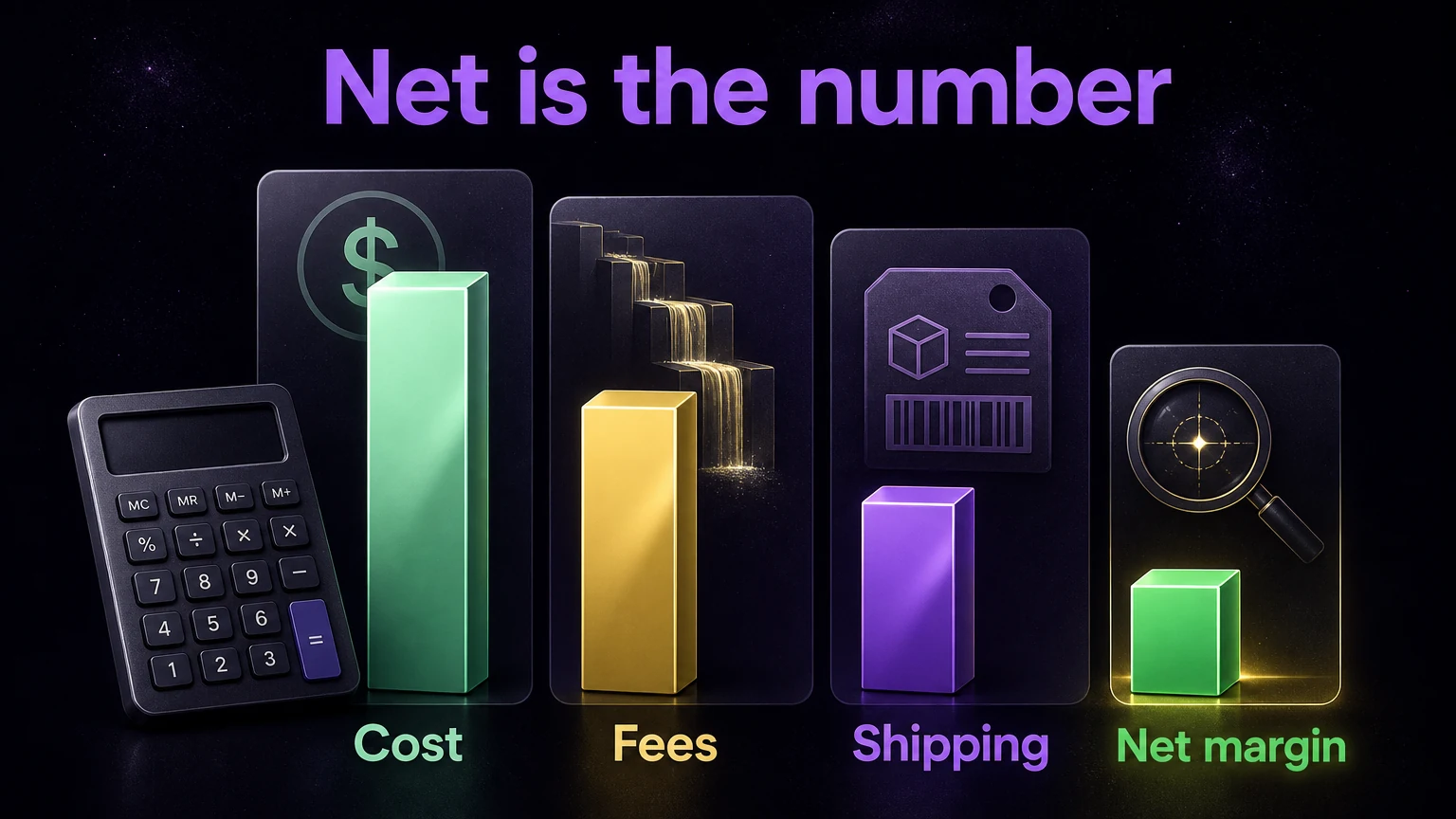
The truth is that the sale price is the top of a waterfall, and money leaks out at every step on the way down. Marketplace fees. Shipping. Packaging. Sometimes returns. Then, at the end of the year, income tax on whatever survived. What lands in your bank account is the net, and net is the only number that pays your rent.
Here is the reframe you need to carry into every buy:
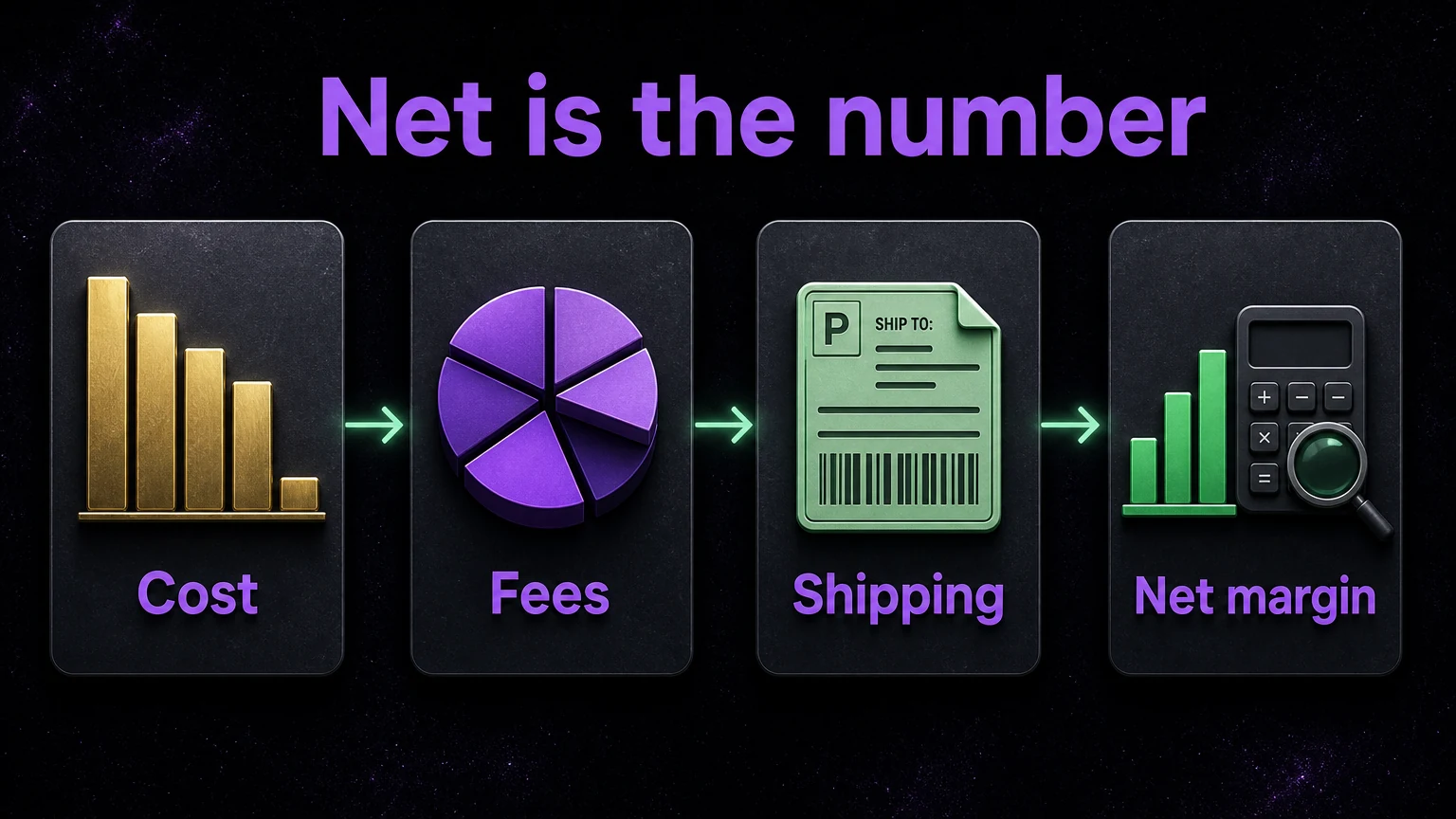
Profit = sale price minus cost minus fees minus shipping minus returns minus your time. Then tax on what remains.
The reseller who wins is not the one who finds the biggest spread. It is the one who knows their real net before they buy, because they already know the comps and the fees cold. Speed to the deal wins the deal. Knowing the true margin decides whether the deal was ever worth chasing.
What actually eats your $200
Let's name every villain that stands between your sale price and your bank balance. None of these are optional. All of them are predictable, which means all of them are plannable.
1. Marketplace fees (the biggest, most ignored bite)
Every platform takes a cut for connecting you to a buyer and processing the payment. On eBay, the standard final value fee often lands around 13% to 14% of the total sale, plus a small per-order fee in many categories. eBay's current standard-category schedule commonly shows 13.6% plus $0.30 to $0.40 per order, so treat "about 13 to 14 percent plus a flat fee" as your planning number and confirm your exact category before you list.
A few category rates worth knowing, because they change your whole margin:
- Authenticated sneakers over $150 on eBay drop to around 8%, a real gift if you flip kicks.
- Books, movies, and music run higher, around 15.3%.
- Jewelry and watches can start around 15%.
Fees are charged on the total the buyer pays, which includes the shipping you charge them and, in some cases, sales tax. That last part surprises people: yes, you can pay a percentage fee on the tax the buyer paid, even though the tax is not your money. That is not a scam, it is just how the total is defined, and you plan around it.
2. Shipping (yours to eat, usually)
If you list "free shipping," you did not make shipping free. You made it yours. A $12 label on a shoebox-sized package is $12 straight off your net. Heavier or larger items eat more. Charge the buyer for shipping and the fee percentage grows with it. Either way, the label is real money leaving your pocket.
3. Packaging and supplies
Boxes, poly mailers, tape, bubble wrap, thermal labels. Call it $1 to $3 per shipment. Trivial on one flip, meaningful across a hundred.
4. Returns and the occasional loss
Not every sale sticks. Buyers return items. Some arrive damaged. Some claims go against you. Bake in a small buffer, because a 3 to 5 percent return rate across many flips is normal and it shaves your average margin whether you like it or not.
5. Unsold inventory (the silent one)
The item that never sells is not a break-even. It is a loss of the cash you tied up, plus the shelf space, plus the opportunity cost of the flip you could have funded instead. This is why sell-through rate matters as much as margin. A 40% margin on something that sells in three days beats a 60% margin on something that sits for eight months.
6. Taxes (the layer people pretend does not exist)
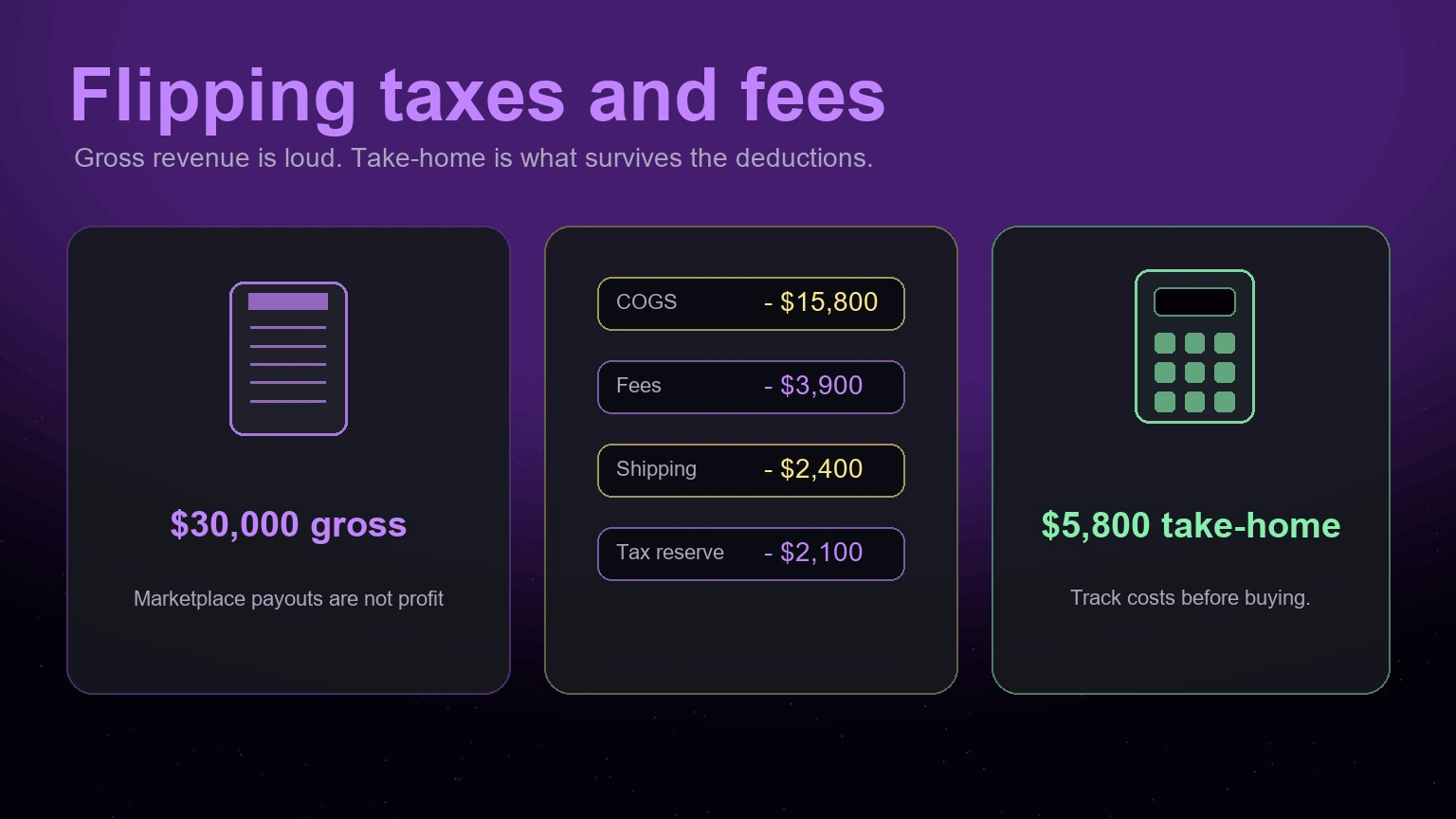
Reselling income is taxable income. Marketplaces issue 1099-K forms, and thresholds have tightened. The net profit you calculate below is pre-income-tax. Your actual take-home is lower still, depending on your bracket. We keep this post focused on the per-flip fee math, but do not forget the final layer. There is a full breakdown in flipping taxes and fees.
The full breakdown: a $200 sale, dollar by dollar
Enough theory. Here is a real flip, run all the way down the waterfall. You bought a collectible or a pair of sneakers at $110. You sold it on eBay at $200 with free shipping to the buyer. You paid a $12 shipping label and $2 in packaging.
| Line item | Amount |
|---|---|
| Sale price | $200.00 |
| eBay final value fee (illustrative 13.6% of $200) | -$27.20 |
| Per-order fee | -$0.40 |
| Shipping label (you pay it) | -$12.00 |
| Packaging | -$2.00 |
| Net proceeds after fees and shipping | $158.40 |
| Cost basis (what you paid) | -$110.00 |
| Net profit (pre-tax) | $48.40 |
So the "$90 flip" is a $48.40 flip before income tax. Just under 55 cents of every dollar you thought you made actually survived.
Now the two numbers that matter, because "profit" alone is not enough to compare deals.
Net margin = net profit divided by sale price. $48.40 / $200 = 24.2% net margin.
Return on investment (ROI) = net profit divided by the cash you put in. Your cash in was cost plus shipping plus packaging = $110 + $12 + $2 = $124. $48.40 / $124 = 39.0% ROI.
Those are two different truths about the same flip. Net margin tells you how much of the sale price you keep, which matters for pricing. ROI tells you how hard your cash worked, which matters for deciding what to buy next. A cheap item can post a lower net margin but a monster ROI, and that is often exactly the flip you want, because your capital recycles faster.
Front-load this habit: before you buy, you should already be able to say the sale price, the fee, the shipping, and the net. If you cannot, you are buying blind, and buying blind is how the shelf fills with dead inventory.
Same sale, three platforms: where the fee bites hardest
The $200 flip does not net the same everywhere. The platform is a lever, not a fixed cost. Here is the same $110-cost item sold at $200 across three common venues, using each platform's real fee structure.
| Platform | How fees work | Fees on $200 | Ship / handling | Net profit vs $110 cost |
|---|---|---|---|---|
| eBay | About 13% to 14% plus a small per-order fee on the total | ~$26.80 to $27.60 | ~$14 (label + packaging) | ~$48.40 to $49.20 |
| StockX (Level 1) | ~9% transaction + 3% processing | ~$24.00 | ~$5 (prepaid label to StockX) | ~$61.00 |
| StockX (promo processing) | ~9% transaction + 0% processing | ~$18.00 | ~$5 | ~$67.00 |
| Whatnot | 8% commission on item + 2.9% + $0.30 processing on total | ~$22.10 | ~$14 (label + packaging) | ~$53.90 |
A few honest reads on this table:
- StockX looks cheaper here partly because you ship one prepaid label to StockX, not a hand-packed box to the buyer, and you skip the packaging line. But StockX only works for authenticated categories like sneakers, watches, and select collectibles, its transaction fee starts higher for new sellers and only drops as you level up, and there is a $5 minimum seller fee. A limited-time promo removed the 3% processing fee in mid-2026, which is real money while it lasts, but promos end. Do not build a business model on a temporary rate.
- Whatnot splits its take: 8% commission on the item price only, plus a 2.9% + $0.30 payment-processing fee on the total order value (item plus shipping plus tax). Its live-auction format can push final prices higher than a static listing, which can more than offset the fee, but it also demands your time on camera. Electronics run a lower 5% commission, and coins run 4%, so category matters.
- eBay is the flexible default: it sells almost anything, but you eat buyer shipping on "free shipping" listings and the fee lands near the top of this group for standard categories.
The lesson is not "always use platform X." It is that the right venue depends on the item, the category rate, and whether the platform's audience will pay a higher price. Reselling profit margins are a function of the venue as much as the spread.
The levers that actually move your net
Fees are fixed. Your inputs are not. This is where a good reseller separates from a hopeful one, and where a community earns its keep.
Lever 1: Buy cheaper by getting there first
The single biggest driver of margin is your cost basis, and cost basis is set at the moment of purchase. Price errors, clearance glitches, and limited-drop retail all exist for a narrow window, and the person who gets the alert first buys at the low number. Everyone who is slow pays more or pays full retail. This is why price-error alerts and stock monitors exist: they compress the time between "deal appears" and "you own it" from hours of manual refreshing to seconds. Lower buy price flows straight to net profit, dollar for dollar.
Lever 2: Know the comps before you buy, not after
Margin is decided before the sale, when you choose what to pay. If you know the honest resale comp (not the one hopeful listing at a fantasy price, the actual sold prices) you know your net before you commit a dollar. Buying blind and hoping the comp holds is how hype cards and dead sneakers end up as inventory you cannot move. Check sold listings, not asking prices. Aim for margin that survives the full fee waterfall, not just the top-line spread.
Lever 3: Pick the venue that fits the item
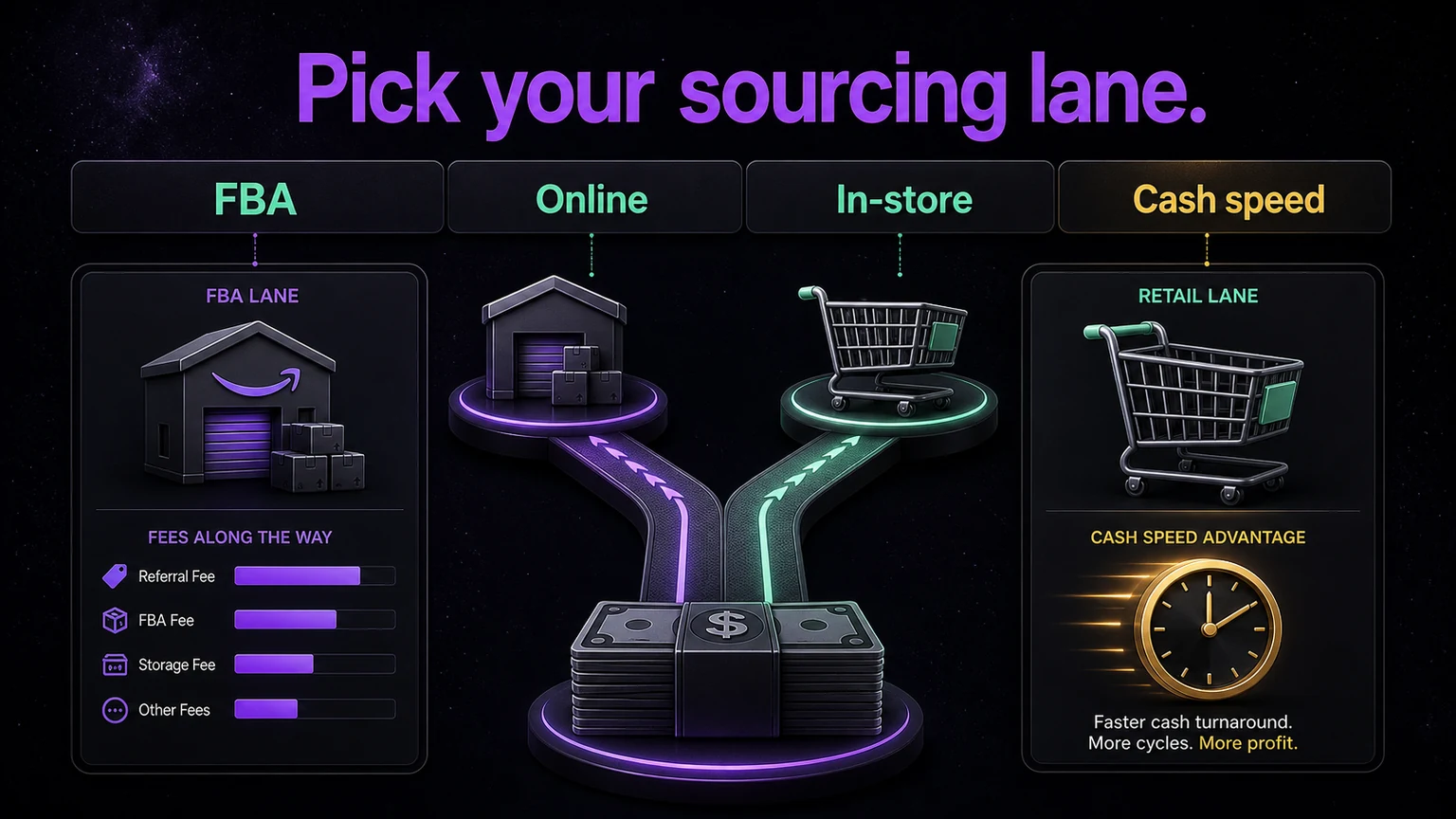
As the table showed, the same item nets differently by platform. Authenticated sneakers over $150 love eBay's 8% category rate or StockX's authentication trust. A live audience of collectors might bid a card higher on Whatnot than it would ever fetch as a static listing. Matching item to venue is free margin.
Lever 4: Protect capital with sell-through
A flip that sits is capital in jail. Favoring items with fast, proven sell-through means your cash recycles into more flips per month, which compounds far harder than squeezing an extra few points of margin out of a slow mover. Speed of turnover is a margin lever, even though it never shows up on a single sale.
Lever 5: Cut the effort so you can do more volume
You cannot manually watch fifty SKUs across a dozen retailers. Tools can. Monitors, alerts, and autocheckout software handle the scanning and the speed so your attention goes to judgment: which deals clear real margin. That is the mechanism a serious reselling group is built around.
This is exactly the gap Divine on Whop is built to close: release alerts, price-error and clearance pings, card pricing help, free autocheckout software for limited drops, and a network of resellers who post real comps and real wins. The tools do the scanning. You keep the margin.
Who should skip the margin grind
Honesty is the sell here, so here is the part most guides bury.
- If you refuse to track comps and fees, reselling will feel like gambling, because you will keep celebrating $90 flips that netted $49. The math is the job. If you hate the math, this is not your side income.
- If you are counting on guaranteed profit, stop now. There is no such thing. Items sit unsold. Hype cards crash. Returns happen. Fees rise, as eBay's did this year. A real reseller plans for losses and still comes out ahead on volume and discipline, not on any single "sure thing."
- If you have no time, be honest about it. Alerts save you the refreshing, but you still have to buy, pack, ship, and handle the occasional return. It is a business with real work, not a machine that prints money while you sleep.
- If your capital is truly tight, start small and cheap, where a single dead item cannot sink you. Do not put rent money into a $600 flip on a hunch.
None of that is meant to scare you off. It is meant to arm you. The resellers who last are the ones who respected the costs from day one.
Run your own numbers before you commit
Here is a repeatable checklist to run on every potential flip, in order, before you spend a dollar:
- Find the honest comp. Sold prices, not asking prices. That is your realistic sale price.
- Subtract the platform fee. Use roughly 13 to 14 percent plus a flat fee for eBay standard categories, or your platform's real rate.
- Subtract shipping and packaging. Weigh and size the item. Do not guess low.
- Subtract a small returns buffer. A few percent across many flips keeps you honest.
- You now have net proceeds. Subtract your cost basis. That is net profit, pre-tax.
- Divide by sale price for net margin. Divide by cash-in for ROI. Compare against your minimums.
- Sanity-check sell-through. Will it move fast enough to free your capital?
If the net margin and ROI clear your bar and the item sells quickly, buy it. If not, walk. The discipline to walk is the whole game.
Want the alerts and comps that make step one and step two automatic? Start a 5-day free trial of Divine Pro. If your focus is sports and trading cards, the Divine Cards Pass runs the same playbook on card monitors and flip alerts.
FAQ
What is a good profit margin for reselling?
There is no single magic number, because margin and ROI tell different stories. Many resellers aim for a net margin above roughly 20% after all fees and shipping, and an ROI north of 30 to 50% on the cash they put in. Cheaper items can post lower dollar profits but much higher ROI because your capital recycles faster. The right target depends on your sell-through speed and how tied up your cash can afford to be.
How much does eBay take from a $200 sale?
For many standard categories, eBay's final value fee is about 13% to 13.6% of the total sale, plus roughly $0.30 to $0.40 per order. On a $200 sale with free shipping, that is around $26.80 to $27.60 in eBay fees alone, before you subtract your shipping label, packaging, and item cost. Some categories differ: authenticated sneakers over $150 drop to about 8%, while books and music run higher near 15%.
Do I pay marketplace fees on shipping and sales tax too?
Often, yes. eBay and Whatnot calculate the payment-processing portion of their fees on the total order value, which can include the shipping you charged and the sales tax the buyer paid. It feels unfair to pay a fee on tax that is not your money, but it is standard, so build it into your planning number rather than getting surprised by it.
What is the difference between margin and ROI?
Net margin is net profit divided by the sale price, and it tells you how much of the sale you keep. ROI is net profit divided by the cash you invested, and it tells you how hard your money worked. The $200 flip in this post shows a 24.2% net margin but a 39.1% ROI, two true numbers about the same deal. Use margin to price, use ROI to decide what to buy next.
Is reselling income taxable?
Yes. Resale profit is taxable income, and marketplaces issue 1099-K forms once you cross reporting thresholds. Every net-profit figure in this post is pre-income-tax, so your real take-home is lower depending on your bracket. Track your costs and receipts all year, because legitimate business expenses (fees, shipping, supplies, cost of goods) reduce what you owe. See flipping taxes and fees for the full picture.
Which platform has the lowest fees for resellers?
It depends on the item. StockX can be cheaper for authenticated sneakers and watches, especially during its processing-fee promo, and you skip buyer packaging. Whatnot splits an 8% commission plus processing and can lift final prices through live auctions. eBay is the flexible default with fees near 13 to 14 percent for standard categories but the widest audience. Match the item and category to the venue instead of loyalty to one platform.
The verdict
Sale price is a headline. Net is the story. Once you run the full waterfall, fees, shipping, packaging, returns, and finally tax, you stop chasing fat-looking spreads that quietly net nothing and start stacking clean flips that actually clear your bar. The math is not the hard part. Doing it before you buy is.
The two edges that move net the most are the ones a solo reseller struggles to get alone: buying cheaper by being first to the deal, and knowing the honest comp before you commit. That is the entire reason a tool-backed community exists. If you want the alerts, comps, and autocheckout that turn "I hope this clears margin" into "I already know my net," try Divine Pro free for 5 days.
Realistic expectations: reselling is a real business with real costs, including fees, shipping, taxes, unsold inventory, and your time. Profits are not guaranteed, prices and platform fees change, and every flip carries risk. Always run your own comps and your own numbers before you buy.
Get to the deal first
Divine is the alert network, monitors, and autocheckout built on this exact process. Try Divine Pro free for 5 days.
Reselling is a real business with real costs: marketplace fees, shipping, taxes, and unsold inventory. Profits are never guaranteed. Always check the comps before you buy.