Amazon FBA vs retail arbitrage: which fits you
Amazon FBA vs retail arbitrage vs online arbitrage, compared on fees, effort, capital, and speed. Honest math, a comparison table, and how to pick.
Turn this into live alerts.
Use the Divine Pro free trial to see sneaker, retail, card, price-error, and autocheckout alerts before you pay.
Start Divine Pro free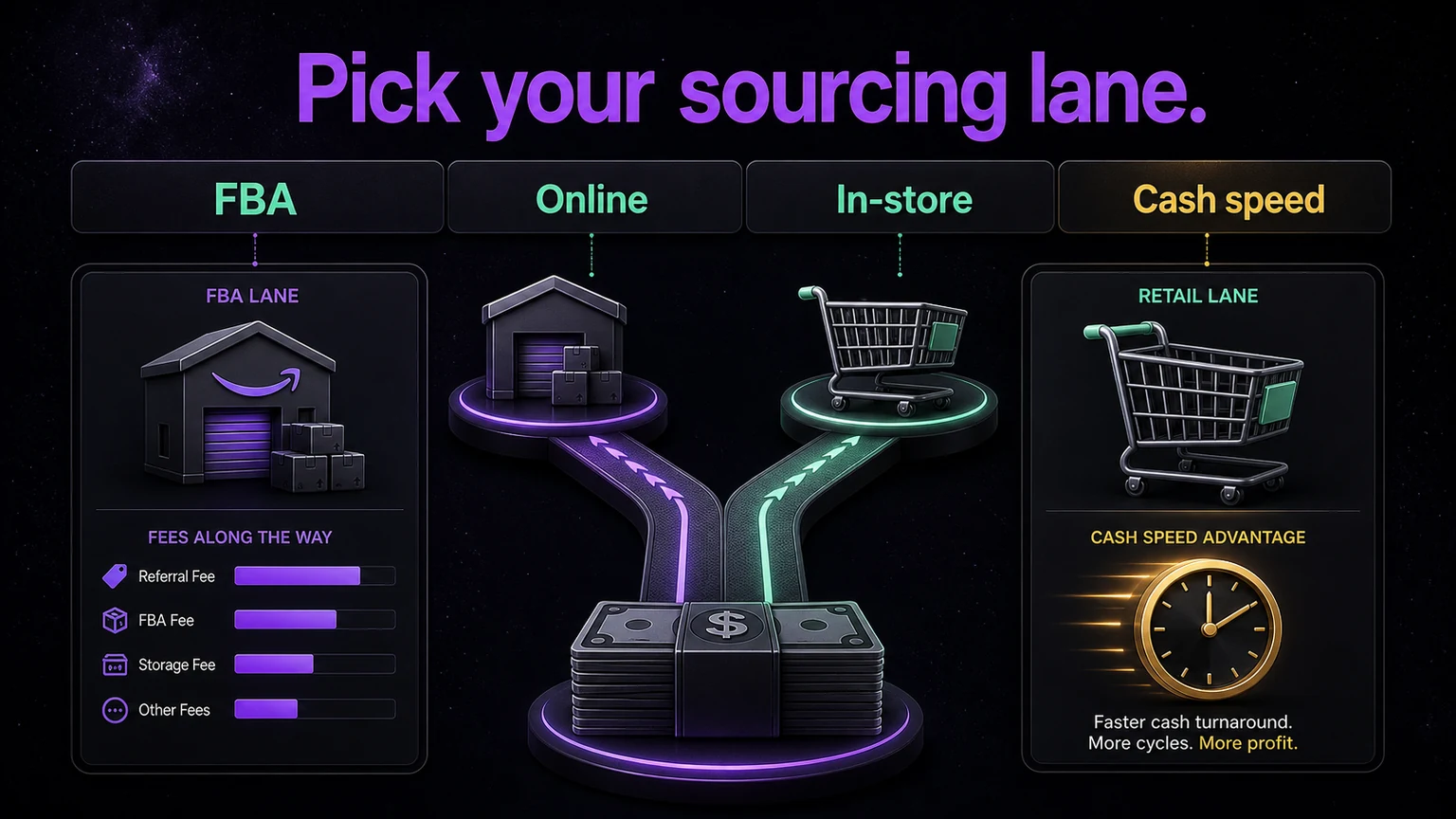
You saw the reel. A guy in a rented office says he built "passive income" with Amazon FBA. He waves a phone showing a sales graph. He does not show you the four hours he spent scanning clearance shelves, the boxes stacked in his garage, the units stuck in Amazon storage racking up fees, or the referral fee that ate 15 percent of every sale before he saw a cent. He calls it passive. It is a job with a warehouse attached.
Here is the trap. People hear "FBA" and "retail arbitrage" and "online arbitrage" thrown around like three competing money machines, pick one at random, sink a few hundred dollars in, and get surprised when the "passive" model needs their hands on it every day. So let me settle the confusion, put real fees on the table, and show you which model actually fits your capital, your time, and your patience.
The lie that costs beginners the most: "FBA is passive income"
Let me kill this one first, because it warps every decision after it.
FBA is not a sourcing model. It is not a business. It is not passive. FBA stands for Fulfillment by Amazon, and it is a fulfillment method. Amazon stores your inventory, picks and packs orders when they sell, ships them with Prime speed, and handles most customer service and returns. That is real value. It is also the only part of the process Amazon touches.
Everything that makes or loses you money still sits on your side of the table:
- Finding products that sell for more than you pay, after fees.
- Buying them with your own cash.
- Prepping and labeling them to Amazon's spec.
- Shipping them into Amazon's warehouses.
- Watching price, rank, and competition so you do not get stuck.
- Repricing, reordering, and clearing dead inventory.
FBA automates the boring middle of the chain. It does not automate the hunt, the buy, or the risk. Calling FBA "passive income" is like calling a self-checkout lane "passive grocery shopping." Something got automated. It was not the part that decides whether you profit.
So the real question is not "FBA or retail arbitrage." Those are not opposites. The real question has two parts: how will you source (retail arbitrage, online arbitrage, or something else), and how will you fulfill (FBA, where Amazon ships, or FBM, where you ship). Most arbitrage sellers source in stores or online and fulfill with FBA. Getting the vocabulary straight is the first edge, because it stops you comparing a warehouse to a sourcing method and picking wrong.
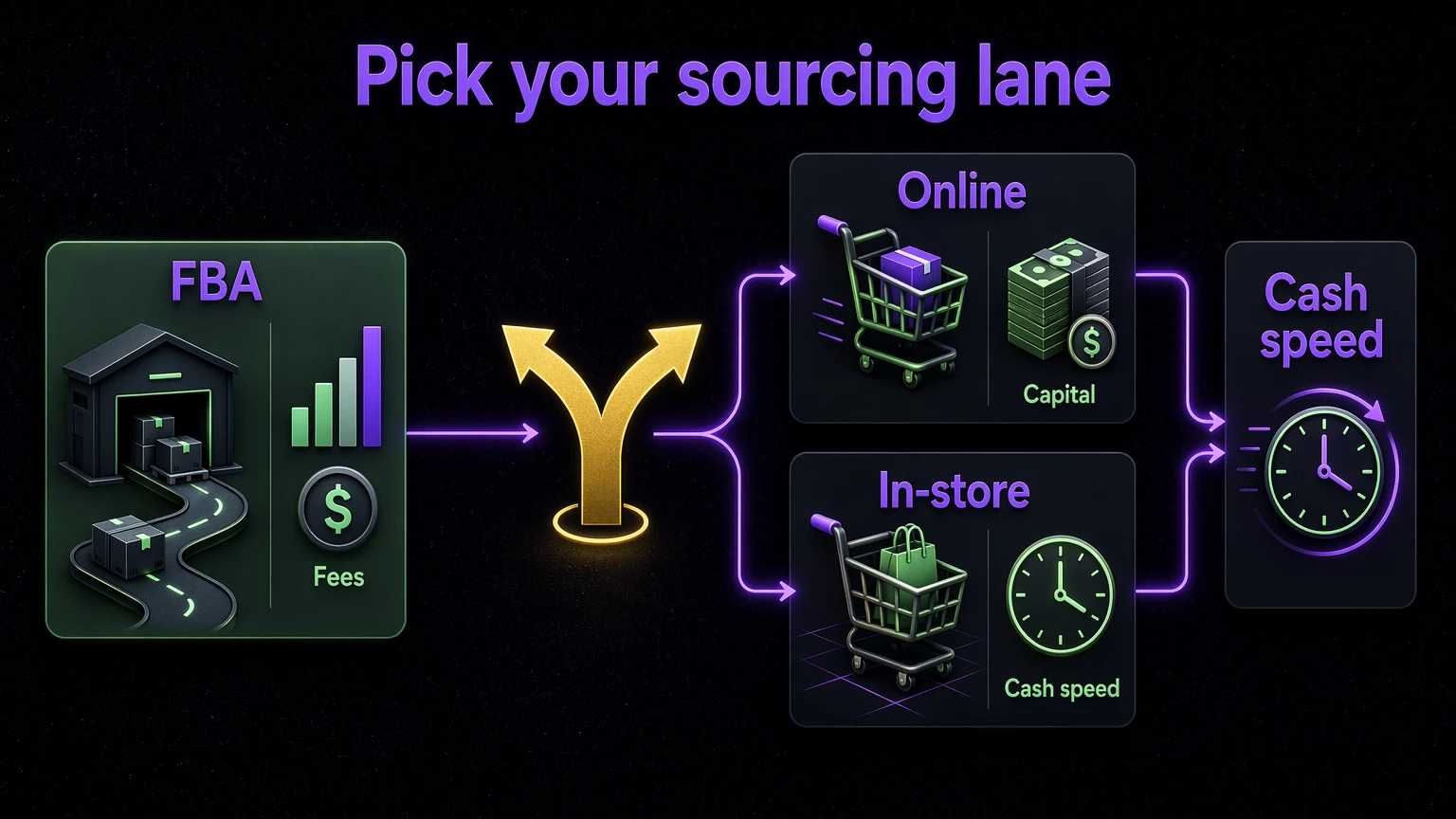
The three models, defined without the hype
Retail arbitrage (RA)
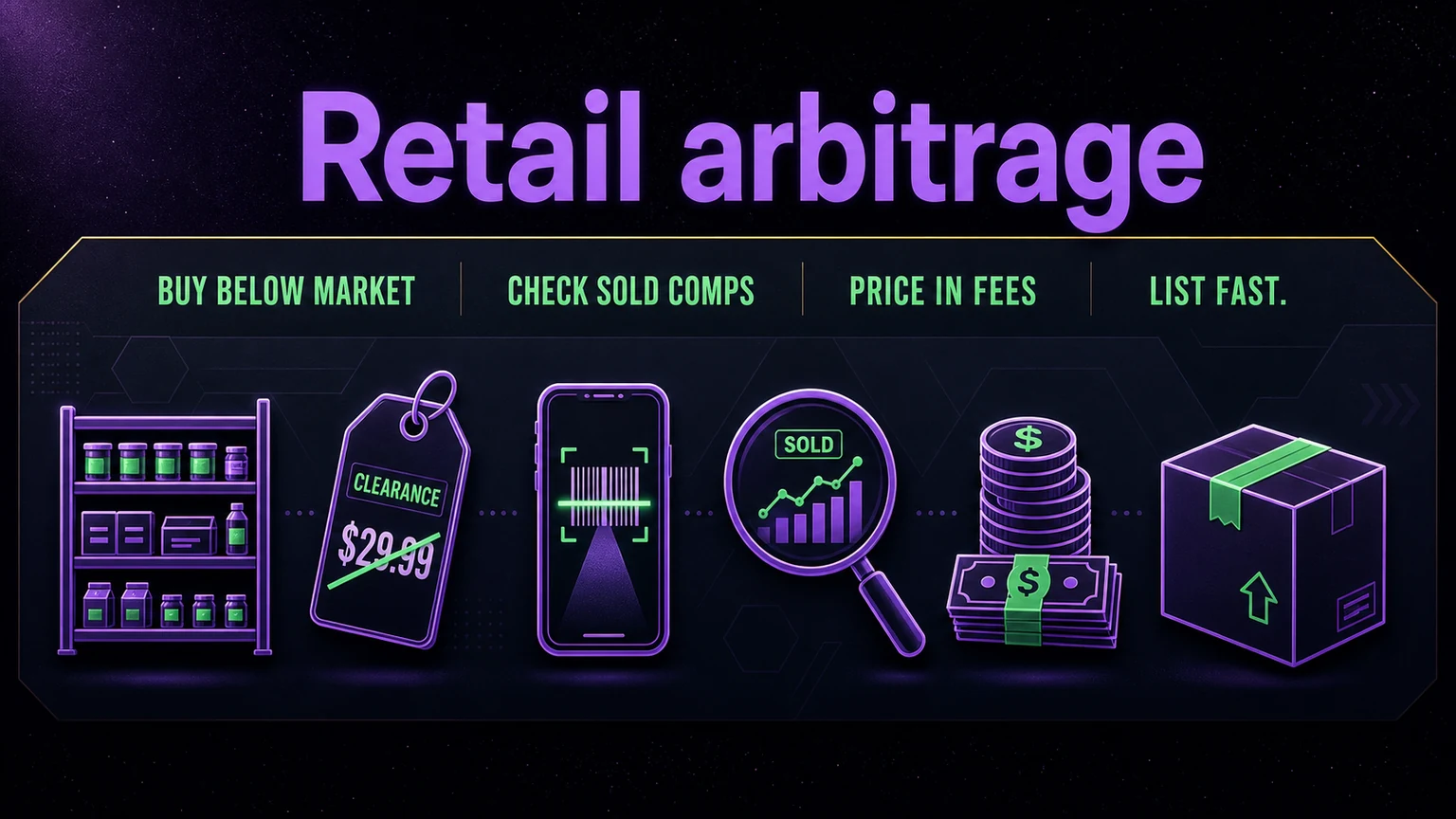
You walk into a physical store, Walmart, Target, a grocery chain, a clearance outlet, and you scan products with an app that shows you the Amazon selling price and estimated fees. When the store price plus fees leaves a margin, you buy. You take the units home, prep them, and ship them into Amazon.
The edge is local and physical. A clearance endcap in your town is invisible to the seller three states over. You can find deals nobody else can touch. The cost is your legs and your hours. Every deal lives inside driving distance, and every hour on the sales floor is an hour you cannot get back. For the full foundation, read what is retail arbitrage.
Online arbitrage (OA)
Same idea, no car. You source from online retailers, catch a sale or a coupon stack or a price error on a retailer site, and buy units that resell higher on Amazon. Deals ship to your door or straight to a prep center, then into Amazon.
The edge is reach and repeatability. You can scan thousands of listings an hour with software instead of one barcode at a time. You can work from anywhere, buy at midnight, and rerun a winning process next week. The cost is competition, because that same deal is visible to every other OA seller with the same tools, so prices compress fast and units sell out in minutes.
Amazon FBA vs FBM (the fulfillment fork)
Whichever way you source, you fulfill one of two ways.
- FBA: you ship inventory to Amazon, they store and ship it, your listings get the Prime badge, and you pay fulfillment plus storage fees. More sales, less handling, more fees.
- FBM (Fulfilled by Merchant): you store and ship every order yourself. No FBA fulfillment fee, but no Prime badge, slower shipping, and you eat the packing and the postage and the returns. More work, fewer fees, usually fewer sales.
Hold that fork in mind. It changes the math below.
The number: what Amazon actually takes
This is where "passive income" reels go quiet. Before you keep a dollar of an Amazon sale, two fees come out, and a third can if your inventory sits.
1. Referral fee. Amazon's commission on the sale, charged as a percentage of the total price including any shipping the buyer pays. Most categories run 15 percent. Some sit lower (electronics and grocery around 8 percent), a few higher (jewelry up to 20 percent). There is a minimum referral fee of $0.30 per item, so on cheap products the percentage can effectively be higher. Referral percentages did not change for 2026.
2. FBA fulfillment fee. A flat per-unit charge based on your product's size tier and shipping weight (Amazon uses the greater of actual weight or dimensional weight). For 2026, a small standard-size unit starts around $3.30 and a large standard-size unit around $4.98, climbing steeply for oversize. In 2026 Amazon also made the selling price a factor, so the same box can cost a little more to fulfill when it sells for more. On top of that, from April 17, 2026, Amazon adds a 3.5 percent fuel and logistics surcharge on FBA fulfillment fees. On a roughly $5 fulfillment fee, that is about $0.13.
3. Storage fee. Roughly $0.75 per cubic foot per month for standard-size items from January through September, and about $2.40 per cubic foot in the October to December peak. Small if your units sell fast. A slow bleed if they sit.
Rates change and vary by exact size and category, so always confirm your specific numbers in Amazon Seller Central or the FBA Revenue Calculator before you buy. But the shape holds: referral plus fulfillment plus storage, and that is before your product cost, your inbound shipping, and any prep-center fee.
Worked example: a clean-looking flip, honestly
Say you find a toy on a store clearance rack for $28. On Amazon it sells at $45, a price you confirmed against real comps, not the highest fantasy listing. Large standard size, sells within a few weeks.
- Sale price: $45.00
- Referral fee (15 percent of $45): -$6.75
- FBA fulfillment fee (~$4.98 plus 3.5 percent surcharge): -$5.15
- Inbound shipping into Amazon (est. per unit): -$0.50
- Prep center fee (est. per unit): -$1.00
- Product cost: -$28.00
Net profit: $3.60 per unit. Net margin on the sale: 8 percent. Return on your $28: about 13 percent.
That $17 spread between buy and sell looked like $17 of profit. After Amazon and logistics, four fifths of it vanished. Buy 100 units and you clear roughly $360, minus your hours and minus any units that do not sell. That is a real, workable flip. It is not passive, and it is not the 50 percent margins the gurus quote. Realistic net margins in arbitrage sit closer to 10 to 20 percent after all fees, and this example lands right in that band. See the full breakdown in reselling profit margins explained.
Now flip one input. Say the store price was $32 instead of $28. Same sale, same fees, and your net drops to $0.60 a unit, a rounding error away from a loss. That is the whole game: the fees are fixed and brutal, so your edge is buying low enough and knowing the comp before you touch it. Miss the fee math and a "profitable find" quietly becomes a loss you discover a month later.
Ready to source deals that survive the fee math? Join Divine on Whop to get clearance, price-error, and glitch alerts pushed to you instead of scanning shelves blind.
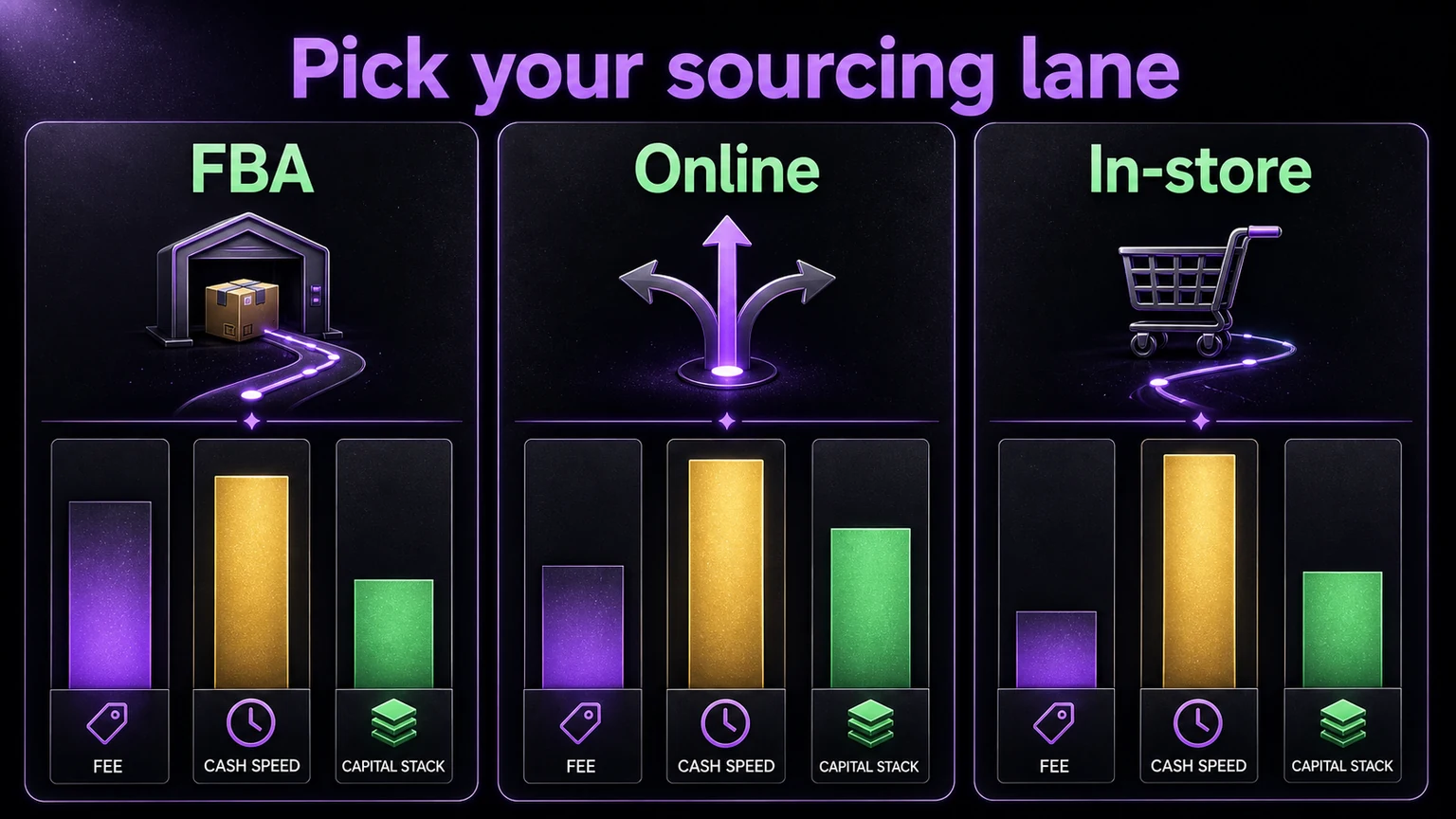
Fee and effort comparison table
Here is the honest side by side. "Fees" assumes you sell on Amazon; the referral fee applies no matter how you fulfill.
| Factor | Retail arbitrage + FBA | Online arbitrage + FBA | Self-fulfilled (any sourcing + FBM) |
|---|---|---|---|
| Startup capital | Lowest, roughly $100 to $300 in inventory plus gas | Moderate, often $500 and up for batch buys | Low to moderate, no FBA fees but you buy packing and postage |
| Amazon referral fee | ~15% typical (8% to 20% by category), $0.30 minimum | Same ~15% typical | Same ~15% typical |
| Fulfillment fee | FBA per unit, ~$3.30 small to ~$4.98 large standard, plus 3.5% surcharge | Same FBA per unit | None from Amazon, but you pay your own postage and materials |
| Storage fee | ~$0.75/cu ft Jan to Sep, ~$2.40 peak | Same | Your own space, "free" but real |
| Physical effort | High, driving and scanning shelves in person | Low to moderate, all screen-based | High, you pick, pack, and ship every order |
| Time to find deals | High per deal, one shelf at a time | High but scalable, thousands scanned per hour with tools | Same as your chosen sourcing method |
| Speed to cash | Fast, inventory turns in days | Moderate, 30 to 60 day delivery and prep cycles | Slower per order, you ship as sales trickle in |
| Scalability | Hard, capped by stores you can reach | Easier, repeatable and software-assisted | Hard, capped by your own labor |
| Prime badge | Yes | Yes | No, usually fewer sales |
| How "passive" | Not passive | Not passive | Least passive |
Read down the "how passive" row. None of them are passive. FBA removes the shipping and the customer-service grind. It does not remove the sourcing, the capital risk, or the daily attention. That is the point.
2026 realities that change the picture
The ground shifted this year, and beginners running on 2022 advice get burned.
- Ungating got stricter. Retail receipts no longer work to ungate restricted brands and categories. You need wholesale invoices or a Letter of Authorization. That quietly narrows what retail arbitrage can even list.
- Commingling ends March 31, 2026. You will need manufacturer barcodes rather than relying on pooled inventory, which means more prep and labeling on your side.
- Amazon-run FBA prep ended January 1, 2026. Many sellers now route inventory through third-party prep centers, which adds a per-unit cost (roughly $1 a unit in the example above) but saves your hands.
- The market thinned. New seller registrations dropped sharply from the prior year, but the sellers who stuck around capture more traffic each. Less tourist competition, higher standards to survive.
- Fees crept, not spiked. FBA fees rose on average about $0.08 per unit for 2026, plus the new 3.5 percent fuel surcharge from April 17. Small per unit, real across hundreds of units.
None of this kills arbitrage. It rewards the sellers who do the fee math cold and source from something better than luck.
Who should pick which
Pick retail arbitrage if: you have little cash, you learn by doing, and you have stores and clearance racks within reach. It is the classic on-ramp. You start with $100 to $300, cycle it fast, and learn how comps and fees behave with real skin in the game. The catch is your legs and your calendar cap how much you can find.
Pick online arbitrage if: you want to work from a screen, scale a repeatable process, and reach far more products than any drive can. You need more upfront capital for batch buys and you will fight more competition on every deal, because the deal is visible to everyone with the same tool. The upside is you can rerun a winning system without leaving your desk.
Pick FBM over FBA if: your product is large, heavy, slow-selling, or your margins are too thin to survive the fulfillment fee, and you have the space and the willingness to pack and ship yourself. FBM trades your labor for lower Amazon fees.
Run a hybrid, which is what most durable sellers actually do: source in stores when a local clearance beats anything online, source online when the screen finds it faster, and fulfill with FBA on fast movers and FBM on the awkward stuff. The best deal wins, regardless of where it came from.
Whatever you pick, the constraint is the same: you cannot flip what you never find. The margin is set by your buy price, and your buy price is set by how early you catch the deal. That is a sourcing problem, and sourcing is exactly where a good alert network earns its keep. Divine's real-time alerts push clearance, glitches, and price errors to you so the hunt stops eating your whole day.
Who should skip all of this
Honest gate, because the caveats are the sell.
- You want truly passive income. This is not it. If nobody in the picture is willing to source, buy, prep, monitor, and reinvest, walk away and keep your money.
- You cannot float unsold inventory. Cash sits in boxes and in Amazon's warehouse for weeks. If that $300 is rent money, do not risk it. Some units will not sell, and storage fees nibble while they wait.
- You skip the comp check. If you will not confirm the real selling price and fees before you buy, every "deal" is a coin flip and the fees are rigged against you.
- You expect 50 percent margins. Real net margins run 10 to 20 percent after fees. If that spread does not excite you at volume, this is the wrong game.
- You cannot handle rules changing. Ungating, prep, and fee rules shifted in 2026 and will shift again. Slow-to-adapt sellers get stranded.
None of that is meant to scare you off. It is meant to make sure the people who stay are the ones who will actually profit. The real enemies here are paying full retail, buying blind without a comp, chasing hype that crashes, and the fake gurus who sell "passive" so they never have to show you the boxes in the garage.
FAQ
Is Amazon FBA the same as retail arbitrage?
No. Retail arbitrage is a sourcing method, buying discounted products in physical stores to resell. FBA is a fulfillment method, where Amazon stores and ships your inventory. You can do retail arbitrage and use FBA to fulfill it, or use FBM and ship yourself. They answer two different questions: where you buy, and who ships.
Is Amazon FBA really passive income?
No. FBA automates storage, shipping, and most customer service. It does not source products, spend your capital, prep your units, or watch your prices. You still run the business every day. Treat it as a fulfillment tool that saves labor, not an income stream that runs itself.
How much money do I need to start?
Retail arbitrage can start around $100 to $300 in inventory plus gas money, which is why it is the common on-ramp. Online arbitrage usually wants more, often $500 and up, because you buy in batches. On top of inventory, budget for Amazon fees, possible prep-center fees, and inbound shipping. Never start with money you need for rent, because it sits tied up in inventory for weeks.
What fees does Amazon take on each sale?
Three main ones. A referral fee, usually about 15 percent of the sale price with a $0.30 minimum. An FBA fulfillment fee, a flat per-unit charge from roughly $3.30 for small standard to $4.98 for large standard in 2026, plus a 3.5 percent fuel surcharge from April 17, 2026. And storage fees, around $0.75 per cubic foot most of the year and higher in the holiday peak. Confirm your exact numbers in the Amazon FBA Revenue Calculator before you buy.
Which is more profitable, retail or online arbitrage?
Neither wins on margin alone; both land around 10 to 20 percent net after fees when done well. Retail arbitrage turns cash faster and can find deals nobody else sees locally, but caps out at how many stores you can visit. Online arbitrage scales further and runs from a screen, but faces more competition on every deal. Profit follows sourcing discipline and fee math, not the label on the model.
Do I still owe taxes on Amazon arbitrage income?
Yes. Resale income is taxable, and Amazon and payment processors report sales, so this is not off-the-books side cash. Track your cost of goods, fees, shipping, and mileage so you are taxed on profit, not revenue. See flipping taxes and fees for the thresholds and the take-home math.
Verdict: pick the model, then feed it deals
Stop asking "FBA or retail arbitrage." Wrong question. FBA is how you ship. Retail and online arbitrage are how you source. If you have little cash and stores nearby, start with retail arbitrage and fulfill with FBA. If you want to scale from a screen, run online arbitrage. Most sellers who last run both and let the best deal win. None of it is passive, and the fees are fixed and unforgiving, so your only real lever is buying low enough with a comp you trust.
That lever is sourcing, and sourcing is where speed and information decide the margin. A network that pushes clearance, price-error, and glitch alerts turns the slowest part of the job, finding the deal, into something that comes to you. Join Divine on Whop for the 5-day free trial and see whether the alert flow fits how you source before you pay a cent. If you want to pressure-test which model suits you, pair this with best items to flip for profit and how monitors and alerts work.
Realistic expectations: reselling is a business with real costs, marketplace fees, shipping, taxes, unsold inventory, and your time. Profits are not guaranteed, rates and rules change, and some units will not sell. Do your own comps and confirm current Amazon fees in Seller Central before you buy.
Get to the deal first
Divine is the alert network, monitors, and autocheckout built on this exact process. Try Divine Pro free for 5 days.
Reselling is a real business with real costs: marketplace fees, shipping, taxes, and unsold inventory. Profits are never guaranteed. Always check the comps before you buy.