Flipping taxes and fees: what you actually take home
Flips are not tax-free side cash. See how 1099-K rules, marketplace fees, and shipping cut your take-home, with a full worked year-of-flips example.
Turn this into live alerts.
Use the Divine Pro free trial to see sneaker, retail, card, price-error, and autocheckout alerts before you pay.
Start Divine Pro free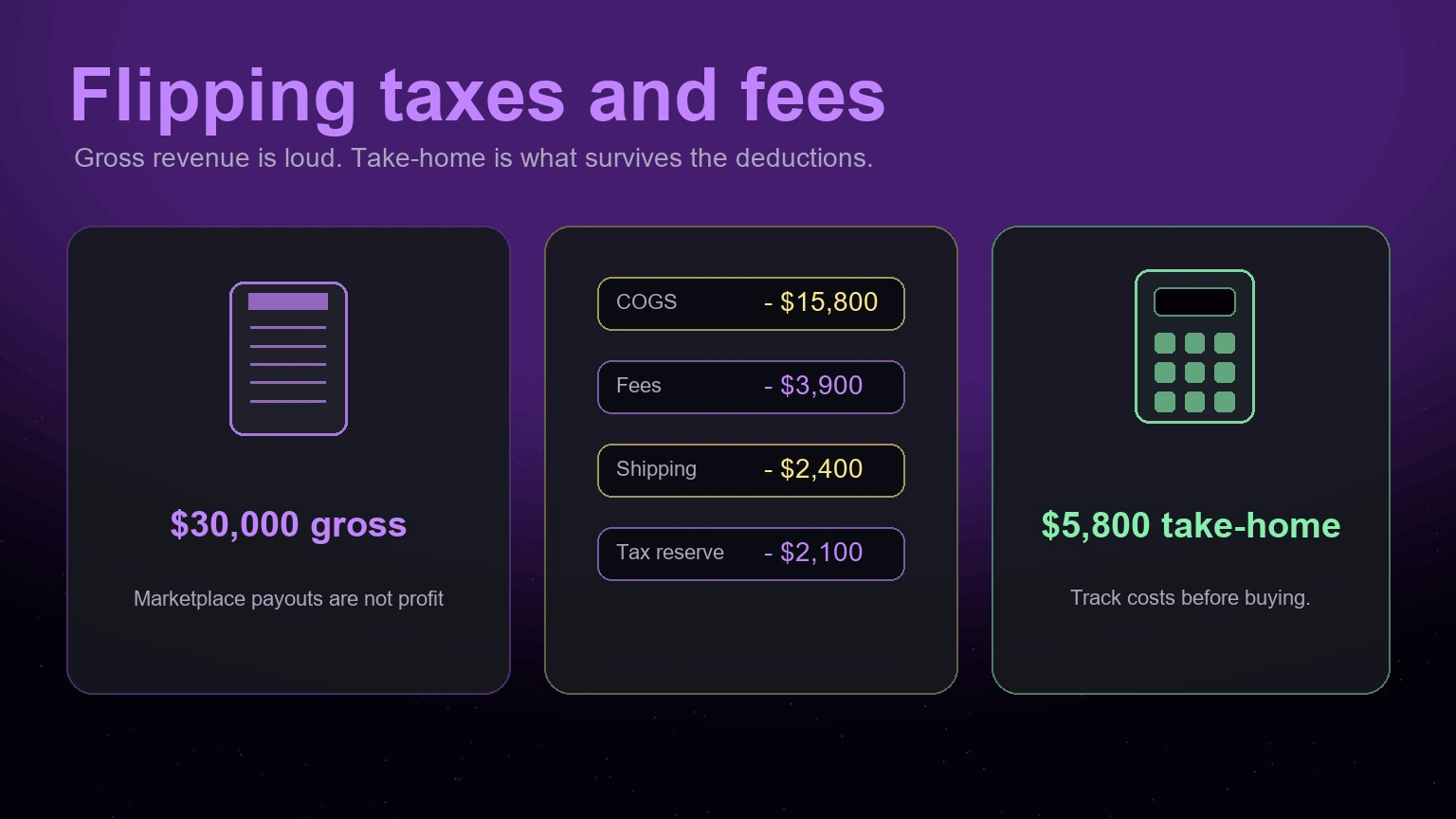
You sold 200 items last year. Thirty grand moved through your PayPal and your marketplace payouts. You felt rich for about a week. Then a form showed up in January with a number on it, and suddenly the "easy side cash" had a paperwork problem attached.
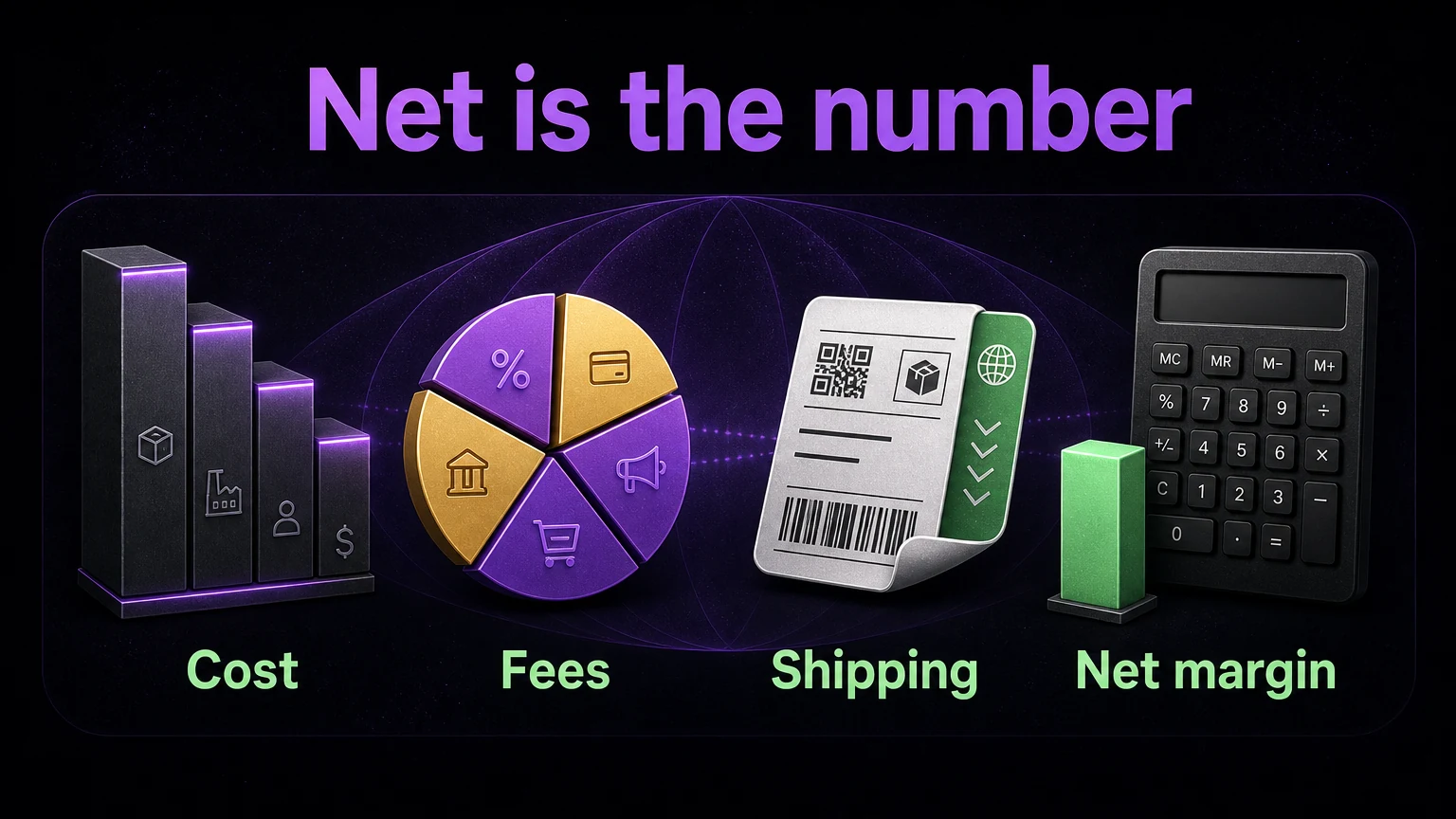
Here is the part nobody screenshots for their reselling flex: gross is not profit, and profit is not take-home. The buyer paid roughly $30,000. You will keep a fraction of that. Fees ate a slice, shipping ate a slice, the cost of the goods ate the biggest slice, and then the IRS came for a bite of what was left. If you have been treating flip money as invisible tax-free income, this post is the cold water.
The lie is comforting: flips are tax-free side hustle money, off the books, nobody's business. The fix is boring and true. Resale income is taxable whether or not a platform sends you a form. The real question is not "do I owe tax," it is "what do I actually keep after fees and tax on a full year of flips." We are going to run that number to the dollar.
The one belief that costs flippers the most
"I only owe tax if I get a 1099-K."
That sentence has cost more resellers more money in penalties than any bad buy ever did. It is wrong, and it has always been wrong.
A 1099-K is a reporting form, not a tax rule. It is the marketplace or payment app telling the IRS "this person moved money through us." Whether or not that form gets generated, your legal obligation is the same: report income when you sell something for more than you paid for it. The form is a spotlight. Turning off the spotlight does not make the money disappear from the tax code.
So the villain here is not the taxman. The villain is the myth that flip income is free money, because that myth is exactly what turns a profitable year into a penalty notice. Price it in from day one and you keep more, sleep better, and scale without fear.
The 1099-K threshold, and why it keeps changing
This is the part that has whiplashed every reseller for four years straight, so let us pin down where it actually landed.
The One Big Beautiful Bill Act, signed in July 2025, rolled the federal 1099-K reporting threshold back to the pre-2021 level. For the 2025 and 2026 tax years, a marketplace or payment app generally must send you a 1099-K only if both of these are true:
- Your goods and services payments exceed $20,000, and
- You had more than 200 transactions.
That is a hard reversal of the road we were on. The American Rescue Plan Act had pushed toward a $600 trigger with no transaction count. The IRS phased in a $5,000 line for 2024 and a $2,500 line for 2025, with $600 looming for 2026. The new law scrapped that ramp. For 2025 and 2026, it is back to $20,000 and 200 transactions.
Now read the trap in that, because it is the whole point of this section.
The threshold controls whether a form gets mailed. It does not control whether you owe tax. Do 150 flips for $18,000 in profit and get no 1099-K? You still owe tax on the profit. The IRS is explicit: report all taxable income even if no form arrives because you fell under the threshold.
A few more edges worth knowing:
- States can be stricter. Several states set their own 1099-K threshold as low as $600 regardless of transaction count, and state and federal rules do not have to match. Check your state.
- Payment card transactions have no minimum. Card processors report from dollar one.
- Platforms can send a form voluntarily even when you are under the federal line.
- Personal items sold at a loss are treated differently. If you sell your own used gear for less than you paid, that is generally not reportable income, though a 1099-K can still generate and you may have to reconcile it on your return.
Bottom line: the $20,000 and 200 number tells you when a form shows up. It never tells you the tax is optional.
Sources on the current rule: IRS FAQs on the OBBBA 1099-K threshold and the TaxAct threshold breakdown.
Hobby or business: the fork that changes your whole tax bill
Once you accept the income is taxable, the next question decides how much you actually pay. The IRS sorts flippers into two buckets, and the buckets are wildly different.
Hobby. You do it for fun, occasionally, without a real profit motive. Hobby income is taxable and reported on Schedule 1. Here is the sting: you generally cannot deduct your expenses against hobby income. The Tax Cuts and Jobs Act suspended that deduction, and the 2025 tax law made the suspension permanent. So your fees, shipping, and supplies do not shrink your taxable number the way they should.
Business. You do it to make money, with intent and consistency. Business income goes on Schedule C. You can deduct ordinary and necessary expenses, which lowers both your income tax and your self-employment tax. The tradeoff: net profit is subject to that self-employment tax of 15.3%, and you may owe quarterly estimated payments.
So which are you? The IRS does not use one rule. It weighs the whole picture. Some of the questions it asks:
- Do you keep real books and records?
- Does your time and effort show you intend to profit?
- Do you actually turn a profit in some years, and how much?
- Do you depend on the income?
- Do you change tactics to become more profitable?
- Do you and your advisors have the knowledge to run it well?
A common rule of thumb: if you turned a profit in three of the last five years, the IRS will usually treat it as a business. And note the one mercy in the code: if your net earnings from the activity are under $400 in a year, you generally do not owe self-employment tax, even if it is business income.
Here is the counterintuitive part most people get backwards. If you are flipping seriously, business status is usually the better deal, because the ability to deduct your cost of goods, fees, and shipping saves you far more than the self-employment tax costs you. The hobby path sounds lighter and often taxes you harder, because it strips your write-offs.
Details from the IRS hobby-versus-business guidance and Kiplinger's breakdown of hobby income.
The fees nobody prices in before they buy
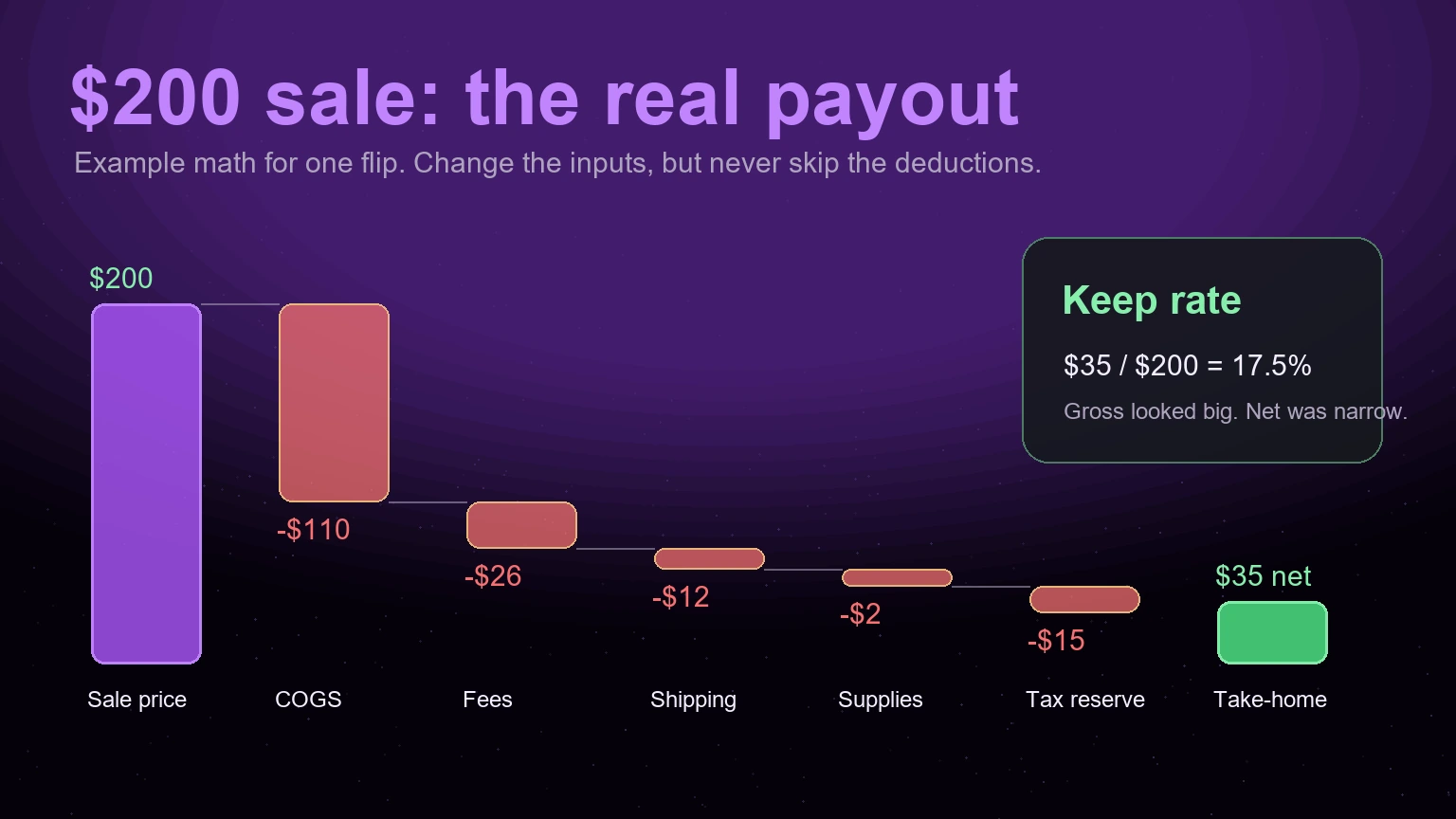
Before tax even enters the room, the marketplace has already taken its cut. If you are only comparing your buy price to the sold price, you are lying to yourself about margin. Price this in at the moment you source, not at tax time.
Rough, checkable fee ranges most flippers hit:
| Cost | Typical range | Notes |
|---|---|---|
| Marketplace final value fee | About 13% to 14% plus a per-order fee in many eBay categories | Varies by platform and category. Current eBay standard categories often show 13.6% plus $0.30 to $0.40 per order, while cards, sneakers, stores, and seller status can differ. |
| Payment processing | Often folded into the final value fee | Standalone processors run roughly 2.9% plus $0.30. |
| Shipping | $5 to $15 per order for typical items | You either pay it or price it in. Heavy or oversized costs more. |
| Shipping supplies | ~$0.50 to $2 per order | Mailers, boxes, tape, labels, ink. |
| Ad or promoted-listing fees | 2% to 12%+ when used | Optional, but common on slow-moving inventory. |
| Returns and disputes | Variable | A single lost dispute can erase several good flips. |
Two flips at the same sold price are not the same flip. A $200 pair of sneakers that ships in a light box beats a $200 item that ships in a $22 oversized box, every time. Speed to the deal and knowing your comps before you buy is the whole game, and the fee table is why. For the full margin mechanics, see reselling profit margins explained and what is retail arbitrage.
The number: a full year of flips, from gross to take-home
This is the part that matters. Let us run a realistic year, business status, Schedule C, and follow the money all the way down to what lands in your pocket. These are illustrative numbers, not a promise about your results.
Say you did 201 flips at an average sold price of $150. Gross sales: $30,150. That clears the federal third-party network reporting threshold only because it is over both lines: more than $20,000 and more than 200 transactions. Payment-card transactions and some state rules can still report differently.
| Line | Amount |
|---|---|
| Gross sales (201 flips at ~$150) | $30,150 |
| Cost of goods (what you paid, ~$95 each) | -$19,000 |
| Marketplace fees (~13.6% plus $0.40 per order) | -$4,181 |
| Shipping you covered (~$10 per order) | -$2,000 |
| Supplies (mailers, tape, labels) | -$200 |
| Mileage, software, misc | -$300 |
| Net profit (Schedule C) | $4,465 |
| Self-employment tax (~15.3% on 92.35% of net) | -$658 |
| Federal income tax (~22% bracket, after half-SE deduction) | -$952 |
| Take-home | ~$3,054 |
Read that bottom line twice. Thirty thousand dollars of gross sales became about $2,900 in your pocket. Roughly ten cents of real, keepable money per gross dollar.
Nothing here is a scam. It is just the math working exactly as designed. The cost of goods was always going to be your biggest line. The fees are the platform's cut for the audience. The tax is on your actual profit, not on the gross. But if you budgeted your life around "roughly $30,000 of flip money," you were off by a factor of ten.
Now flip the comparison to show why business status matters. If the same activity were treated as a hobby, you generally could not deduct the fees, shipping, and supplies. Your taxable income would balloon toward the profit-before-those-costs figure, and your tax bill would climb well past the business scenario even though you kept the exact same roughly $3,050 of economic profit. The write-offs are the entire reason serious flippers file as a business.
Caveats on the model, because honesty is the point: this excludes state income tax, assumes you have clean records for every purchase price, uses a single federal bracket, and assumes buyer-paid shipping was not separately collected. Your real numbers move with your category, your state, and your bracket. Run yours.
Where flippers actually lose the money
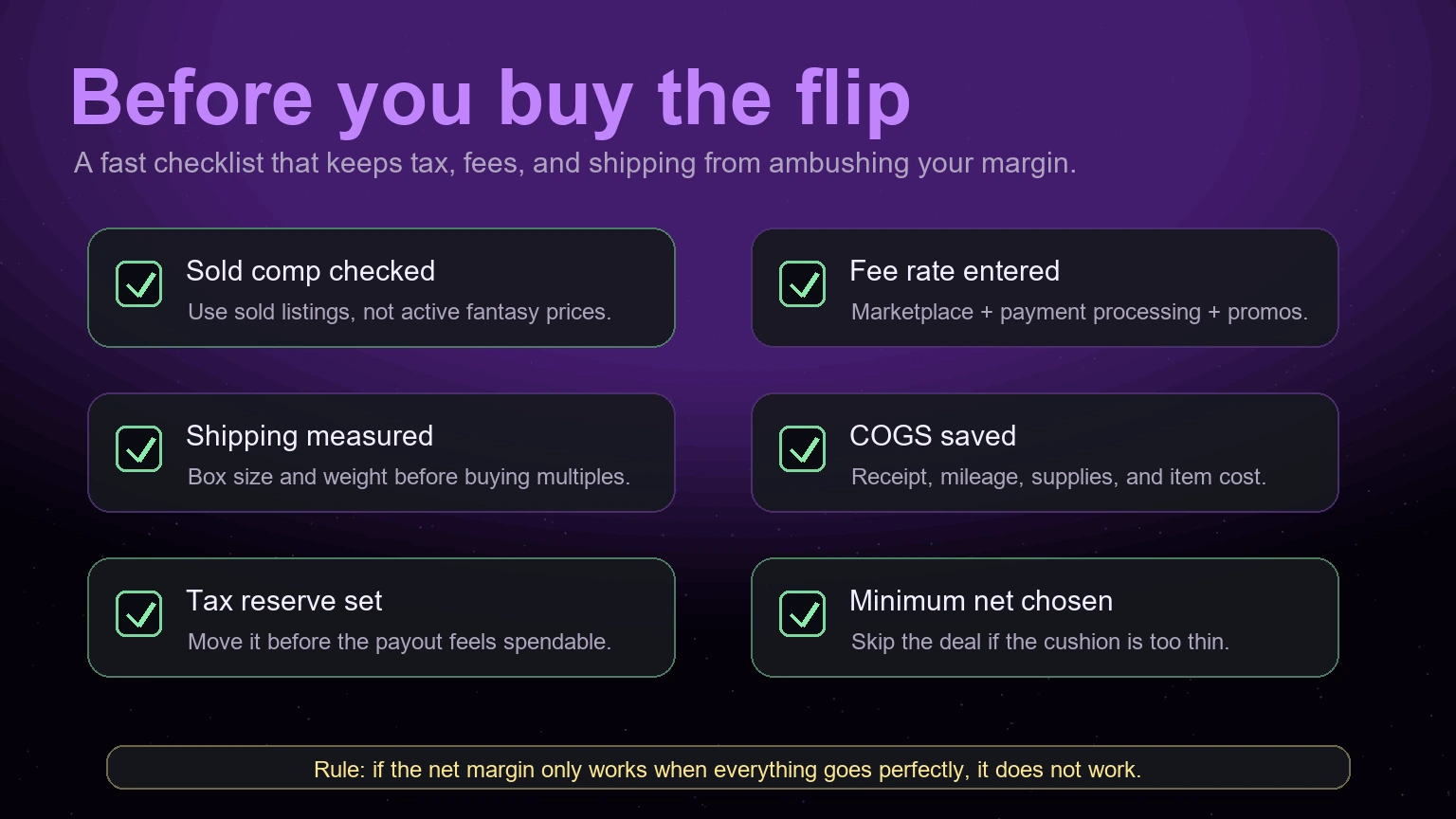
The tax is predictable. These are the leaks that quietly wreck a year:
- No purchase records. If you cannot prove what you paid, you can lose the cost-of-goods deduction entirely, and the IRS may treat your gross as closer to profit. That is the single most expensive mistake in reselling. Keep receipts.
- Unsold inventory. Cash tied up in cards or shoes that will not move is not a write-off just because it sits there, and it is dead money either way. Sell-through beats sticker price.
- Ignoring quarterly estimates. Business flippers with real profit generally owe estimated tax four times a year. Skip them and you can eat underpayment penalties on top of the tax.
- Mixing personal and business money. One account for flips makes bookkeeping survivable. One blended account makes an audit a nightmare.
- Chasing hype that crashes. A card or shoe that craters before you sell is a loss, not a deduction fantasy. The fix is comps and speed, covered in how to spot price errors and best items to flip for profit.
Keep your reselling records for at least seven years. The IRS generally has three years to audit, but that stretches to six if they suspect significant underreporting. Sources: the TaxSlayer reseller reporting guide and IRS hobby-versus-business factors.
The value levers: keep more without selling more
You do not have to grind more flips to raise your take-home. You can raise it by plugging the leaks.
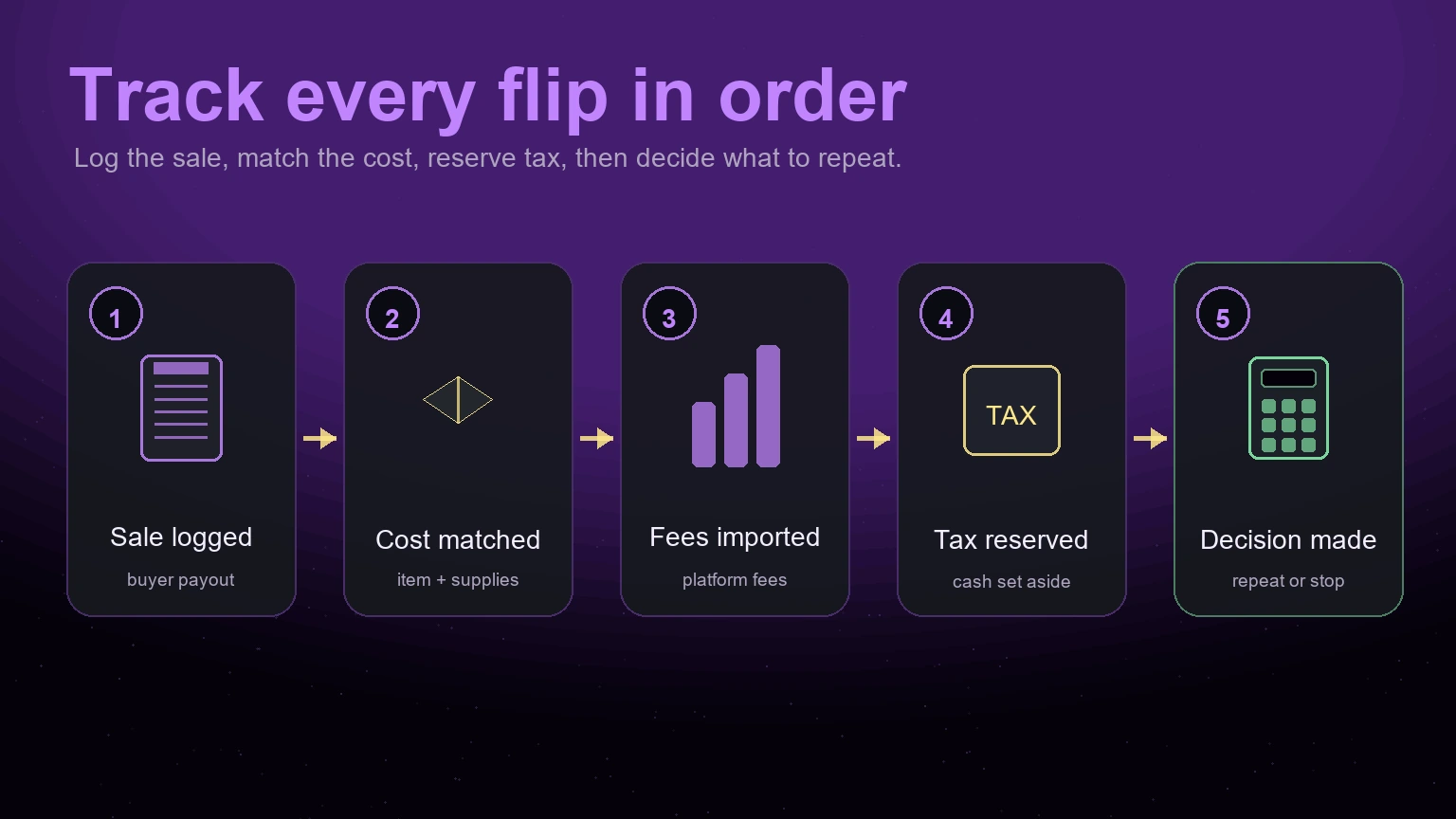
- Track every purchase price at the moment you buy. A spreadsheet or an app turns lost deductions into real ones. This alone can move your tax bill by hundreds.
- Deduct everything the code allows. Cost of goods, shipping, supplies, mileage to source, software, a home-office portion, part of your phone bill. Every legitimate dollar lowers income tax and self-employment tax.
- Buy for margin after fees, not sticker spread. Run the fee table before you commit cash, not after the sale.
- Prioritize sell-through. Fast-moving inventory at a healthy net beats a high-ticket item that sits and ties up cash.
- Get to the deal first. The spread is widest at the drop. The faster you source mispriced or limited product, the more room you have before fees and tax compress it.
That last lever is where a reselling community earns its keep. Real-time release alerts, price-error and clearance pings, card monitors, and checkout tools exist to shrink the time between "the deal appears" and "you own it." That speed is not a guarantee of profit. It is a bigger spread to work with before the costs in this article take their cut. If you want that edge, join Divine on Whop and use the 5-day free trial to see the alert flow before you pay.
Who should skip all of this
Straight talk, because the caveats are the sell.
Skip flipping as income if you will not keep records. Untracked flips are the fastest path from "fun side money" to a penalty letter, and the deduction losses alone will gut your margin.
Skip it if you needed the whole gross sales number to be spendable. Re-read the worked example. Ten cents on the gross dollar is the realistic shape, and it takes real work to get there.
Skip a paid community if you are a casual seller clearing out your closet a few times a year. You are likely under the reporting radar and probably selling personal items at a loss, so alerts and monitors are overkill. A free spreadsheet and honest reporting cover you.
Lean into the tools if you are sourcing consistently, treating it like a business, and the bottleneck is finding enough good deals fast enough to matter. That is exactly the flipper for whom speed and comps change the math.
FAQ
Do I owe tax on flips if I never get a 1099-K?
Yes. The 1099-K is a reporting form, not the tax rule. You are legally required to report income any time you sell something for more than you paid, whether or not a platform sends a form. Falling under the $20,000 and 200-transaction threshold means no form, not no tax.
What is the 1099-K threshold for 2026?
For the 2025 and 2026 tax years, the federal threshold reverted to more than $20,000 in payments and more than 200 transactions, thanks to the One Big Beautiful Bill Act. Note that some states set a much lower threshold, as low as $600, so check your state rules.
Is flipping a hobby or a business for taxes?
It depends on intent and consistency. The IRS weighs whether you keep records, work to profit, and actually make money over time. A common rule of thumb: profit in three of the last five years usually means business. Business income goes on Schedule C with deductible expenses and self-employment tax. Hobby income goes on Schedule 1 and generally cannot deduct expenses.
What can I deduct as a reselling business?
Ordinary and necessary business costs: the cost of the goods you sold, shipping, packing supplies, marketplace and payment fees, mileage to source inventory, software, and a portion of your phone and home office. Every legitimate deduction lowers both your income tax and your self-employment tax. You must be able to prove each expense.
What is self-employment tax and when do I owe it?
Self-employment tax is 15.3%, covering Social Security and Medicare on your net business profit. If your net earnings from the activity are under $400 in a year, you generally do not owe it. Business flippers with meaningful profit usually also owe quarterly estimated tax payments.
How much do I actually keep after fees and tax?
Far less than gross. In the worked example above, $30,150 in gross sales became about $3,050 in take-home after cost of goods, fees, shipping, and tax. Your number depends on your buy prices, category, state, and bracket, but the lesson holds: gross is not profit, and profit is not take-home.
Verdict: price it in, then go get the spread
Flips are not tax-free side cash. Resale income is taxable whether or not a form arrives, fees and shipping take their cut before tax even starts, and the take-home on a big-sounding gross number is a fraction of what the total suggests. That is not a reason to quit. It is a reason to run the numbers before you buy, keep clean records, file the right way, and treat every deductible dollar as money back in your pocket.
The flippers who win are not the ones who dodge tax. They are the ones who buy for margin after every cost, move inventory fast, and get to the deal before the spread closes. If sourcing fast and knowing comps is your bottleneck, a real alerts-and-monitors community is built for exactly that. Try Divine on Whop on the free trial, or if cards are your lane, look at the Divine Cards Pass. Then pair it with the money mechanics in reselling profit margins explained.
Realistic expectations: reselling is a business with real costs, real taxes, and real risk, including fees, shipping, unsold inventory, and drops that sell out in seconds. Profits are not guaranteed. Do your own comps, keep your own records, and consult a qualified tax professional about your specific situation. This article is general information, not tax advice.
Get to the deal first
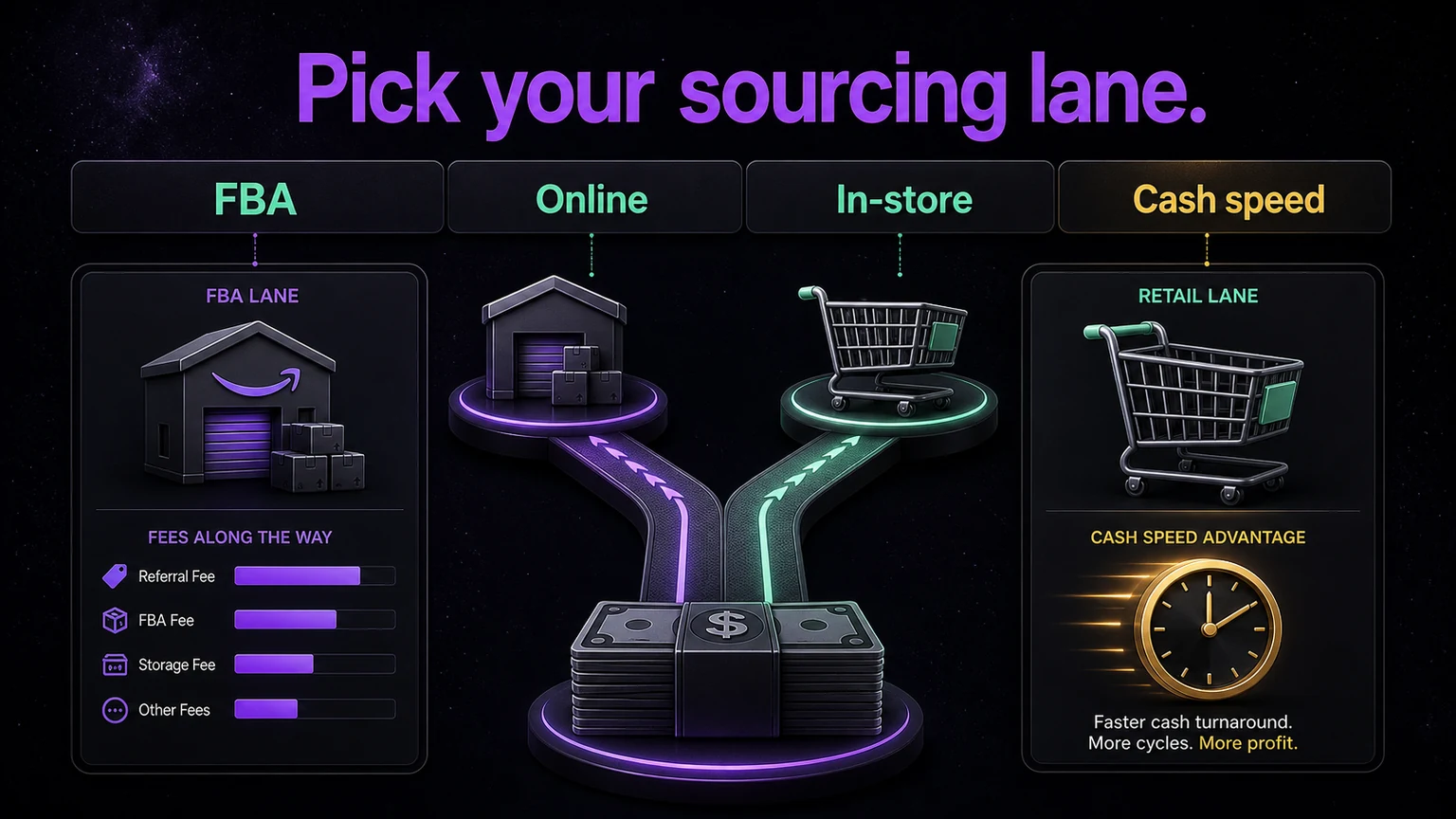
Divine is the alert network, monitors, and autocheckout built on this exact process. Try Divine Pro free for 5 days.
Reselling is a real business with real costs: marketplace fees, shipping, taxes, and unsold inventory. Profits are never guaranteed. Always check the comps before you buy.