Card grading and PSA explained: when slabs pay
Card grading and PSA explained: real 2026 costs, tiers, and the break-even math that tells you when a PSA 10 pays and when the slab just burns cash.
Turn this into live alerts.
Use the Divine Pro free trial to see sneaker, retail, card, price-error, and autocheckout alerts before you pay.
Start Divine Pro free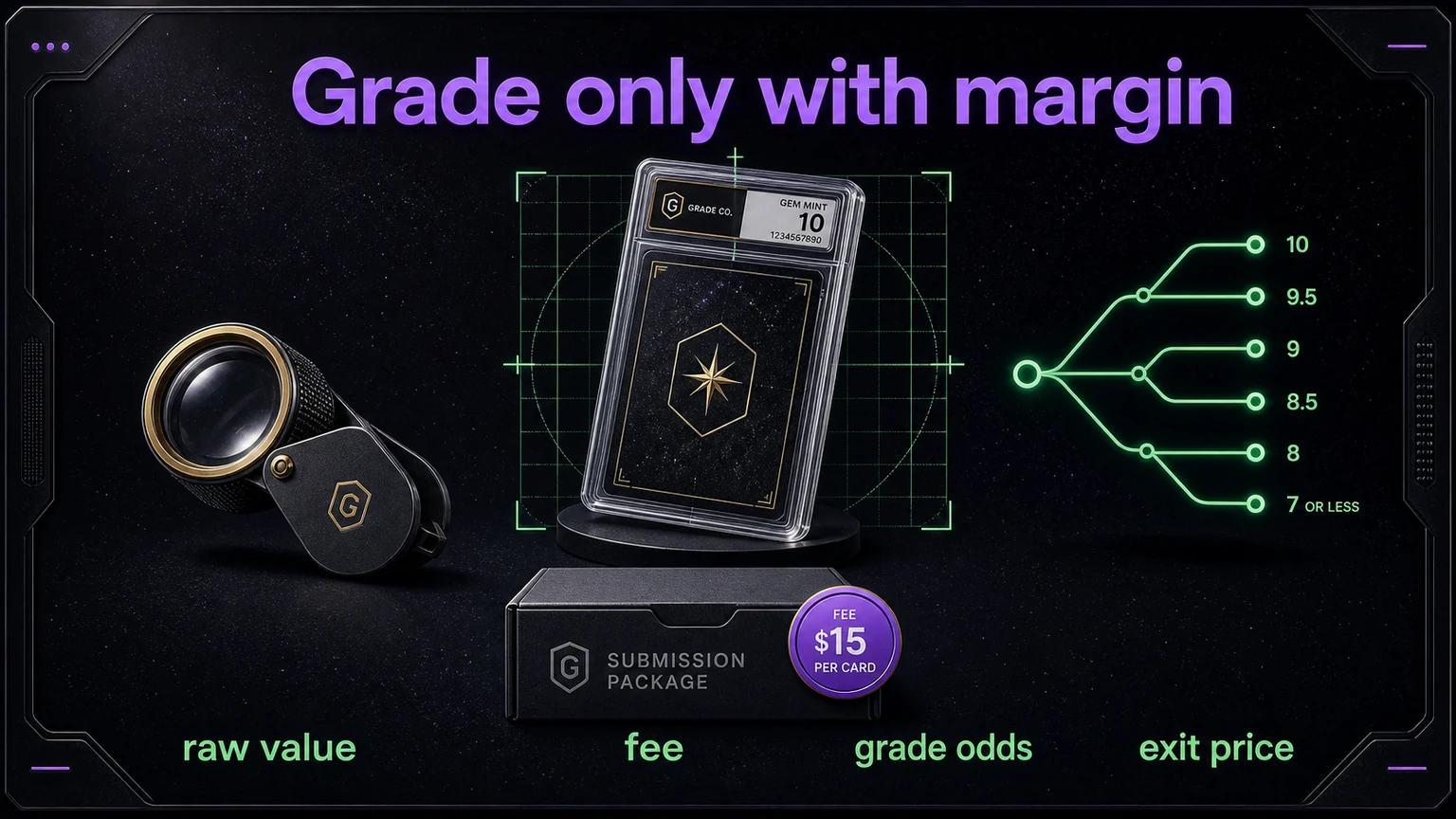
You pulled a clean card. Sharp corners, glossy surface, centering that looks dead on. Somebody in a Discord tells you to grade it, because "grading always adds value." So you drop it in a padded mailer, pay the fee, and wait. And wait. Five months later a slab shows up with a 9 on it, and the market barely blinks. Your $40 card is now a $45 card that cost you $100 and half a year to make. You did not add value. You rented a plastic case at a loss.
Here is the lie that costs collectors the most money: grading always adds value. It does not. Grading costs real money and real weeks, and it only pays above a value threshold, and only if the grade lands where you need it. A slab is not a magic multiplier. It is a bet with a fee attached.
This post breaks the myth with numbers. Real PSA tier prices for 2026. The all-in cost most people forget to add. The PSA 10 premium versus the raw price. And a clean break-even you can run on any card before you spend a dollar. By the end you will know, in your own currency, when to grade and when to just sell the card raw and move on.
What grading actually is
Grading is a third party inspecting your card, authenticating it, and assigning a numeric condition score on a 1 to 10 scale, then sealing it in a tamper-evident holder with a serial number. PSA (Professional Sports Authenticator) is the largest and most liquid name in the space, which matters more than it sounds. Liquidity is the whole point. A PSA slab sells faster and closer to comps than a raw card or a slab from a label buyers do not trust, because the buyer does not have to guess the condition or the authenticity. They trust the label instead of trusting you.
That trust is the product. When you grade, you are not improving the card. The card is exactly as good the day it comes back as the day you sent it. What changes is that a stranger will now pay full comp without haggling, because a recognized authority vouched for the condition. That is worth something. The question is always whether it is worth more than what it costs.
The scale is what makes it a gamble. The jump from a PSA 9 to a PSA 10 is one point on paper and often a multiple on price. Same card, same eyes, a hair of difference in centering or a whisper of a surface line, and the market treats them like two different assets. You are not paying to have your card graded. You are buying a lottery ticket on which number comes back.
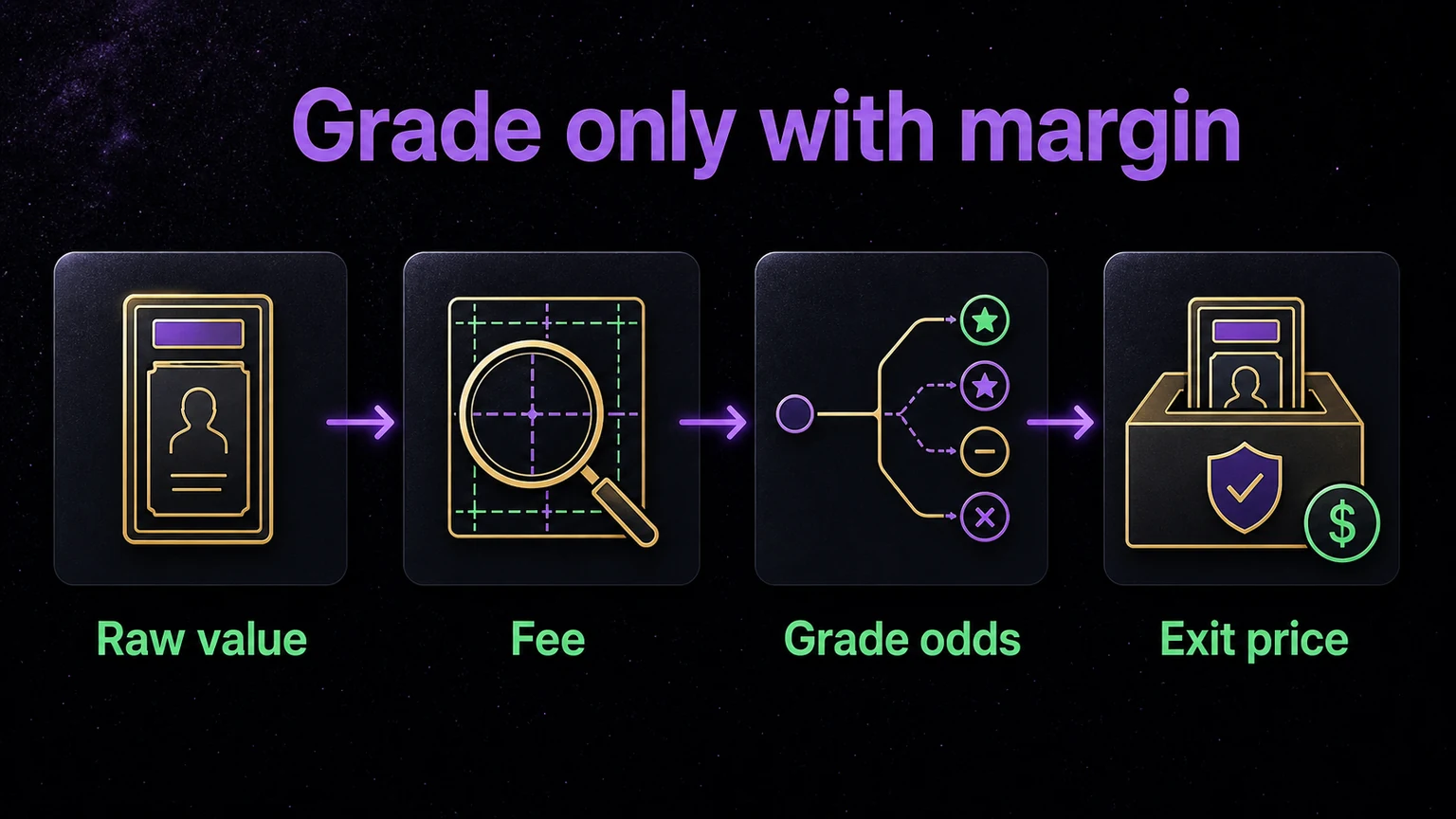
The 2026 PSA price ladder
PSA does not have one price. It has a ladder of service levels, and the level you are allowed to use is set by your card's declared value, which PSA calls the Max Insured Value. A more valuable card cannot ride a cheaper tier, even if you would prefer it. As you climb, two things move together: the value cap rises and the turnaround time drops. You are paying for a shorter queue and a bigger insurance cap at the same time.
There is a catch that reshaped the whole math this year. In June 2026 PSA paused its cheapest tiers (Value Bulk, Value, Value Plus, and Value Max) to work down a backlog that had swollen to roughly 14 million cards. The company said it would take five to six months to pull the queue down toward its target before reopening those levels. So for much of 2026 the real entry point has been Regular at $79.99 per card, not the sub-$30 bulk price collectors got used to. That single change pushed the break-even for grading meaningfully higher.
Here is the ladder as it has stood in 2026, with the value tiers shown as paused. Prices reflect the February 2026 increase. Turnaround is an estimate, not a contract, and it moves with volume.
| Service level | Price per card | Max declared value | Est. turnaround | Status |
|---|---|---|---|---|
| Value Bulk | $24.99 | low bulk cap | 5 to 8 months | paused June 2026 |
| Value | $32.99 | modest cap | multi-month | paused June 2026 |
| Value Plus | $49.99 | modest cap | ~45 days | paused June 2026 |
| Value Max | $64.99 | modest cap | ~35 days | paused June 2026 |
| Regular | $79.99 | $1,500 | ~40 to 50 business days | active entry point |
| Express | $149 | ~$2,500 | faster | active |
| Super Express | $349 | ~$5,000 | under ~2 weeks | active |
| Walk-Through | $599 | ~$10,000 | fastest | active |
| Premium 1 and up | $999+ | higher caps | fastest | active |
Two traps live in this table. First, the upcharge. If PSA finishes grading and decides your card is worth more than the tier you declared, they can bill you the difference to bump you to the correct tier. Your grade does not change, but your bill does. Declare honestly. Second, declared value is not a wish. It is the insurance coverage while PSA holds the card and the gate that decides which tier you can even use.
The cost nobody adds up
The tier price is not your cost. It is a fraction of your cost. Collectors quote the $79.99 and forget the rest, then wonder why the math never works.
Here is the full stack for a direct submission:
- Grading fee: the tier price. $79.99 at Regular in 2026.
- Collectors Club membership: a paid membership (around $99 per year) is required to submit directly to PSA. Amortize it across the cards you send. Send one card and it is brutal. Send twenty and it is a few dollars each.
- Shipping both ways: roughly $15 to $25 total to send your cards in and get the slabs back, more with heavier submissions and full insurance.
- Insurance: commonly $1 to $3 per $100 of declared value, on both legs.
- Supplies: card savers, penny sleeves, team bags, a sturdy box. A few dollars, but not zero.
- Your time: hours of prep, submission forms, and a wait measured in weeks or months. Time is inventory sitting still.
Add it up and the all-in cost per card lands far above the sticker. At the old Value Bulk tier, once membership, shipping, and insurance are spread across a submission, the realistic all-in was roughly $40 to $45 per card. At Regular, all-in runs closer to $100 to $110 per card. That is the number you actually have to beat. Not $79.99. Around $100.
If reselling math is new to you, the same fee-stacking logic runs through every flip you make. We break down the full picture in reselling profit margins explained, and it is worth reading before you send a single card.
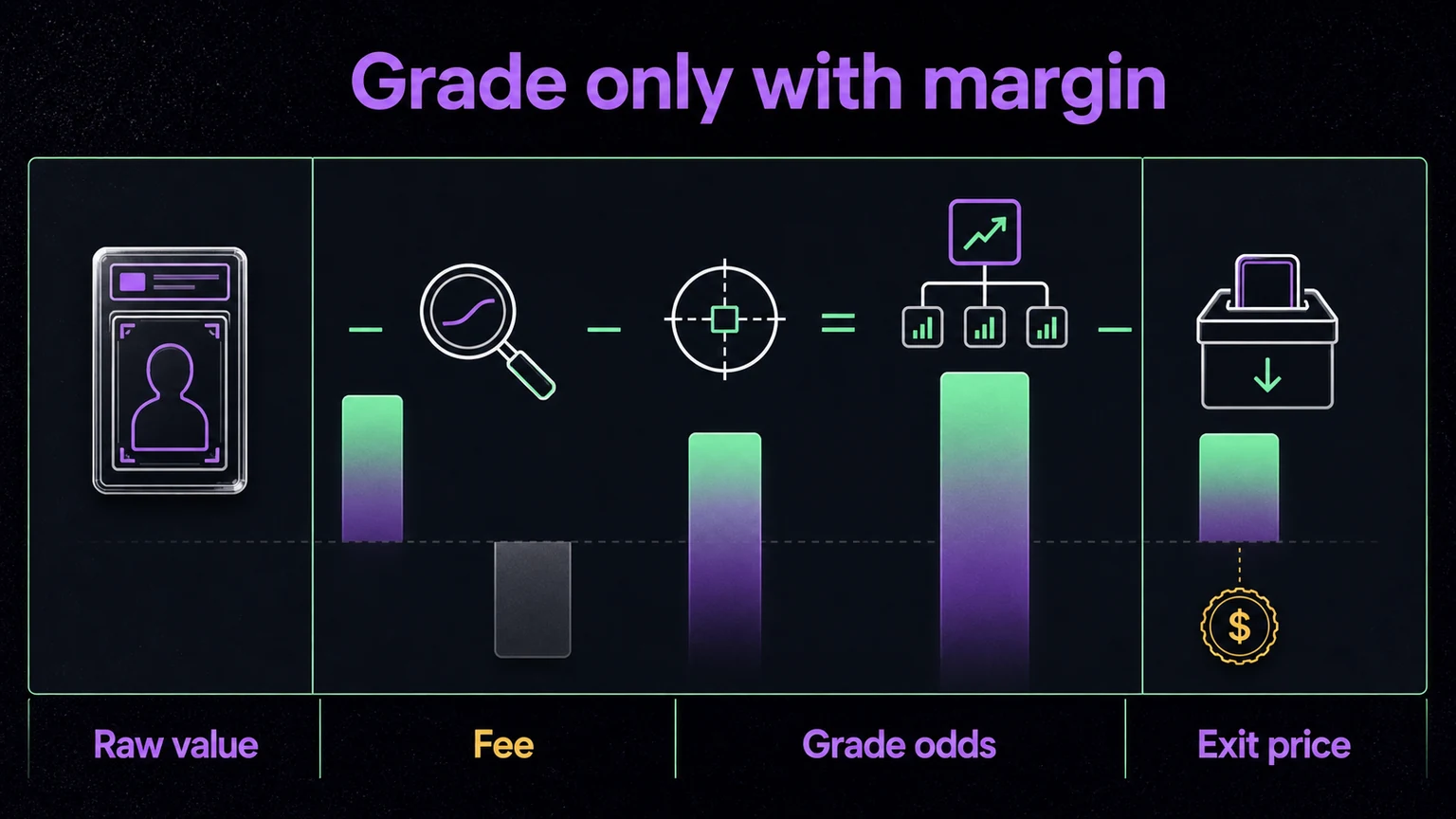
The PSA 10 premium is real, and so is the cliff
Now the upside, because there is real upside. This is why people grade in the first place.
A PSA 10 commands a premium over the raw card, and the size of that premium swings hard by category:
- Modern cards in PSA 10 typically sell for roughly 2x to 5x their raw price. Plan around 3x as a reasonable middle.
- Vintage cards in PSA 10 can fetch 5x to 10x raw, sometimes far more. The famous chase pieces run wild: a first edition base set Charizard worth about $1,900 raw has changed hands around $16,270 in PSA 10, roughly an 8.5x jump.
- By raw value, cards worth $100-plus raw tend to see the biggest lift when they hit PSA 10, while cards under $10 rarely gain enough to cover the fee.
Then the cliff. The drop from PSA 10 to PSA 9 is where dreams go to die. A PSA 9 often sells for only 30% to 50% of the PSA 10 price on the same card. On modern cards it is worse: print quality is so high that a PSA 9 modern card frequently sells for just 10% to 30% over raw, which does not cover grading at all. So a single point, 10 versus 9, can be the entire difference between a clean profit and a slab that clears less than the raw card would have.
This is the part "grading always adds value" ignores completely. The value is not in the slab. It is in the number on the slab, and you do not control the number.
The break-even math, worked
Let us settle this in dollars. The rule is simple: your expected sale price at the most likely grade has to clear your all-in cost with room to spare. Not the dream grade. The likely one.
Example one, the loser everyone makes.
- Raw card value: $30.
- You grade at Regular. All-in cost: about $100.
- Your total in the card: $30 plus $100, so $130.
- It comes back PSA 9 (the most common modern outcome). PSA 9 sells for about 1.2x raw, so around $36.
- You sell on eBay. Final value fees vary by trading-card category and seller setup, so use the current category fee before you submit. On $36 that is about $5.10 in fees.
- Net back: about $30.90. Against $130 in. You lost about $99 and waited two months.
Even if that same card had hit a PSA 10 at 3x raw, so $90, you would net about $77 after fees against $130 in. Still a loss. A $30 card should almost never be graded at Regular. The math is dead before it starts.
Example two, the card worth grading.
- Raw card value: $150.
- Grade at Regular. All-in cost: about $100.
- Total in: $150 plus $100, so $250.
- Most likely grade PSA 9. Say PSA 9 on this card sells for $200.
- eBay fees at roughly 13% to 14% plus a small per-order fee on $200: about $27 to $28.
- Net: about $173. Against $250 in, that is still a loss on a 9. So the 9 alone does not save you.
- Now the PSA 10. At 2.5x raw, that is $375. Fees about $50. Net about $325 against $250 in. Profit of roughly $75.
See the shape of it. On the $150 card you need the 10 to make money, and the 9 is a soft loss instead of a total loss. On the $30 card even the 10 loses. The higher the raw value, the more the grade cushions you, because the PSA 10 premium scales with the base and the fee stays flat.
The clean rule of thumb: the 2x rule.
Take your total cost (raw card price plus all-in grading). Your expected graded value at the most likely grade should be at least double that total. Buy a raw card for $30, grade it for $100 all-in, and your total is $130. If the likely grade is a PSA 9 that sells for $260-plus, grade it. If the likely PSA 9 sells for $60, walk away. The 2x buffer exists because you are wrong about condition sometimes, comps drift, and fees bite.
For most collectors in 2026, the floor lands here: if a card's raw value is under about $50, grading at current prices will likely cost more than it adds. Under $20 to $30 raw, it almost never makes sense. After the February 2026 hikes, that floor moved up, not down. Old guides that tell you to bulk-grade $15 commons are quoting a market that no longer exists.
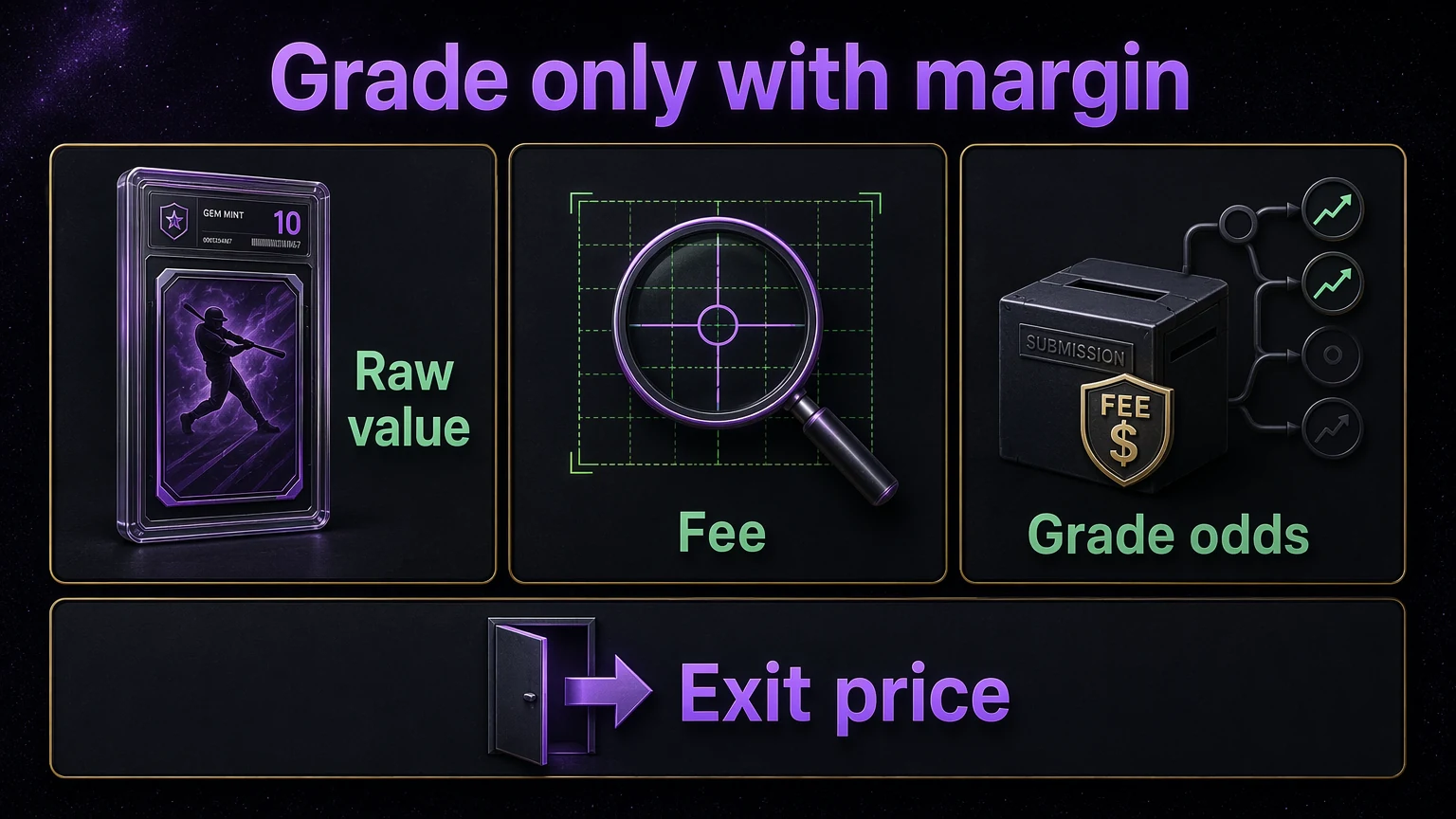
Two levers that move the break-even
The raw price is the big lever. Two more decide whether a borderline card tips into "grade it."
Population. The PSA pop report tells you how many copies already exist in each grade. A card with a huge PSA 10 population has a ceiling on its premium, because supply meets demand. A card with a thin PSA 10 pop can carry a fat premium even at a modest raw price, because graded copies are scarce. Same era, same set, two chase cards: one with a PSA 10 pop near 700 can command a far bigger premium than a sibling sitting at 3,000-plus graded. Check the pop report before you submit. It is free and it is the closest thing to a crystal ball you get.
Hit rate. This is your odds of the 10. For modern, pack-fresh cards that look mint to the eye, a realistic spread is roughly 35% to 55% PSA 10, 30% to 40% PSA 9, and 10% to 15% at PSA 8 or below. So even a genuinely clean card is closer to a coin flip on the 10 than a lock. Centering off by a hair, a tiny print line, a soft corner under the loupe, and you are in 9 territory. If your whole thesis needs the 10 to pay, you are betting on a coin flip, so price it like one.
Reading pop reports, tracking which cards are heating up, and knowing the realistic hit rate before you submit is exactly the edge a good card community sells. The Divine Cards Pass exists for this: card alert monitors and members who spot winning cards early, so you are grading the right cards instead of learning the pop report the expensive way.
Where grading clearly wins
To be fair to the slab, here is where the math flips green:
- High raw value. Cards worth $100-plus raw, where the PSA 10 premium dwarfs the flat fee. This is the sweet spot.
- Thin population, real demand. A card the market wants in a grade that barely exists.
- Vintage in genuinely high grade. The 5x to 10x territory, where even the fee at a fast tier is a rounding error against the upside.
- Authentication value. For high-dollar vintage, the slab also kills the counterfeit discount. Buyers pay full freight for a card they know is real.
- You are a confident grader. You loupe centering, corners, edges, and surface, and you only submit cards that genuinely look like 10s. Grade selection is the whole game.
Grading is a value lever, not a value guarantee. It raises the ceiling on cards that already carry value, cuts the buyer's risk so they pay full comp, and turns a slow, hard-to-verify raw card into a fast, liquid graded one. It does none of that for a $20 common.
Where grading clearly loses: who should skip this
Skip grading, or skip it for now, if:
- Your card is under about $50 raw. The fee eats the gain. Sell it raw.
- The card only pays at PSA 10 and you are not sure it is one. A coin flip on the 10 with a soft loss on the 9 is a bad bet at $100 all-in.
- You need the cash soon. Grading ties up your money and your card for weeks or months. That is real opportunity cost, especially on a hot card you could flip raw today.
- It is a modern common with a giant PSA 10 pop. No scarcity, no premium, no point.
- You are grading for ego, not margin. A slab on the shelf feels great and is a fine hobby choice. Just do not call it an investment when the math says otherwise.
The honest read: most cards most people pull should never be graded. The winners are the exceptions, and finding those exceptions early is the actual skill.
The full flip, start to finish
Put it together on one card so the whole cost stack is visible.
- Buy a raw card with a strong PSA 10 case for $120.
- Grade at Regular, all-in about $100. Total in: $220.
- It comes back PSA 10. Comps say $400.
- Sell on eBay. Fees at roughly 13% to 14% plus a small per-order fee: about $53 to $56.
- Shipping to buyer, insured: about $8.
- Net proceeds: about $338.70.
- Profit: about $118.70 on $220 in, roughly a 54% return, over about two months.
Now the same card comes back a 9 instead.
- PSA 9 comp: $170.
- Fees: about $22.80. Shipping: $8.
- Net: about $139.20 against $220 in.
- Loss: about $80.80.
One card, two outcomes, a $200 swing on a single point. That is grading. The profit is real and so is the risk, and the only way to tilt it in your favor is to submit better cards, at higher raw value, with thinner populations, when you actually believe the 10 is there. If you want the deeper card-selection playbook, start with the Pokemon card investing guide or the sports card investing guide, then come back and run the break-even.
Ready to grade the right cards instead of the expensive ones? The Divine Cards Pass is built to surface winners early with alert monitors and insider tips, so your submissions are the ones worth the fee.
FAQ
Does grading always increase a card's value?
No. Grading only adds net value when the graded price at the likely grade clears your all-in cost, which in 2026 is roughly $100 per card at PSA's Regular tier. On low-value cards, and on any card that comes back below a 10 when the premium lived only at 10, the slab can be worth less than the raw card plus the fee you paid. Grading raises the ceiling on already-valuable cards. It does not create value out of nothing.
How much does PSA grading cost in 2026?
The active entry point in 2026 has been the Regular tier at $79.99 per card, with a $1,500 declared value cap and an estimated 40 to 50 business day turnaround. The cheaper Value tiers were paused in June 2026 to clear a backlog. On top of the fee, budget a paid Collectors Club membership (around $99 per year, amortized across your submission), shipping both ways ($15 to $25), and insurance ($1 to $3 per $100 declared value). All-in, expect roughly $100 to $110 per card at Regular.
What is the difference in price between a PSA 9 and a PSA 10?
Big, and that is the whole risk. A PSA 9 commonly sells for only 30% to 50% of the same card's PSA 10 price. On modern cards the gap is even harsher: a PSA 9 might sell for just 10% to 30% over raw, while the PSA 10 sells for 2x to 5x raw. One point of grade can be the entire difference between profit and loss.
What is the minimum card value worth grading?
As a rule of thumb in 2026, raw value should be at least $50 before grading is worth considering, and the math is far safer above $100. Under $20 to $30 raw, grading almost never pays. Use the 2x rule: your expected graded value at the most likely grade should be at least double your total cost (raw price plus all-in grading fee).
How long does PSA grading take?
It depends on the tier and PSA's current volume, and turnaround is an estimate, not a promise. Faster paid tiers can turn around in under two weeks, while the cheapest tiers historically ran five to eight months. Through 2026, backlog pressure pushed waits longer at the low end. Treat any quoted turnaround as a ballpark and factor the wait into your opportunity cost.
Should I grade a modern card that looks mint?
Only if it clears the break-even and the raw value justifies the fee. Pack-fresh modern cards that look mint still grade PSA 10 only about 35% to 55% of the time, with most of the rest landing at PSA 9 where the premium is thin. If your card only pays at a 10 and it is a coin flip on the 10, that is a weak bet at $100 all-in. Grade high-raw-value modern cards with thin populations, not $20 commons that look clean.
Verdict
Grading is a lever, not a lottery win. It pays when three things line up: the raw value is high enough that the PSA 10 premium dwarfs the flat fee, the population is thin enough that graded copies stay scarce, and you have honestly assessed the card as a real 10 candidate. Miss any of those, and the slab is a slow, expensive way to turn a sellable raw card into a worse one.
Run the 2x rule before every submission. Total your all-in cost, estimate the sale at the most likely grade (usually a 9, not the 10 you are dreaming about), and only grade when the likely outcome still clears the number with room to spare. That single discipline will save you more money than any grading hack on the internet.
The hard part is not the math. It is knowing which cards are worth the bet before you buy them, while the price is still low and the crowd has not caught on. That is where a live card community earns its keep, and it is exactly what the Divine Cards Pass is built for: alerts and insider reads that point you at winners early, so your submissions are the ones that pay. If you also flip sneakers and retail, the broader Divine membership covers the whole reselling side.
Realistic expectations: reselling and grading are a business with real costs, fees, wait times, and unsold inventory, and profits are never guaranteed. Grades are decided by PSA, not by you, and a single point can erase a margin. Run your own comps, check the pop report, and size every bet so a bad grade does not hurt. Nothing here is financial advice. For more on the numbers, see are reselling communities worth it and flipping taxes and fees.
Get to the deal first
Divine is the alert network, monitors, and autocheckout built on this exact process. Try Divine Pro free for 5 days.
Reselling is a real business with real costs: marketplace fees, shipping, taxes, and unsold inventory. Profits are never guaranteed. Always check the comps before you buy.