Sports card investing: why waiting fails
Sports card investing depends on performance, scarcity, grade, and timing. See the math behind rookie-card risk and real margins.
Turn this into live alerts.
Use the Divine Pro free trial to see sneaker, retail, card, price-error, and autocheckout alerts before you pay.
Start Divine Pro free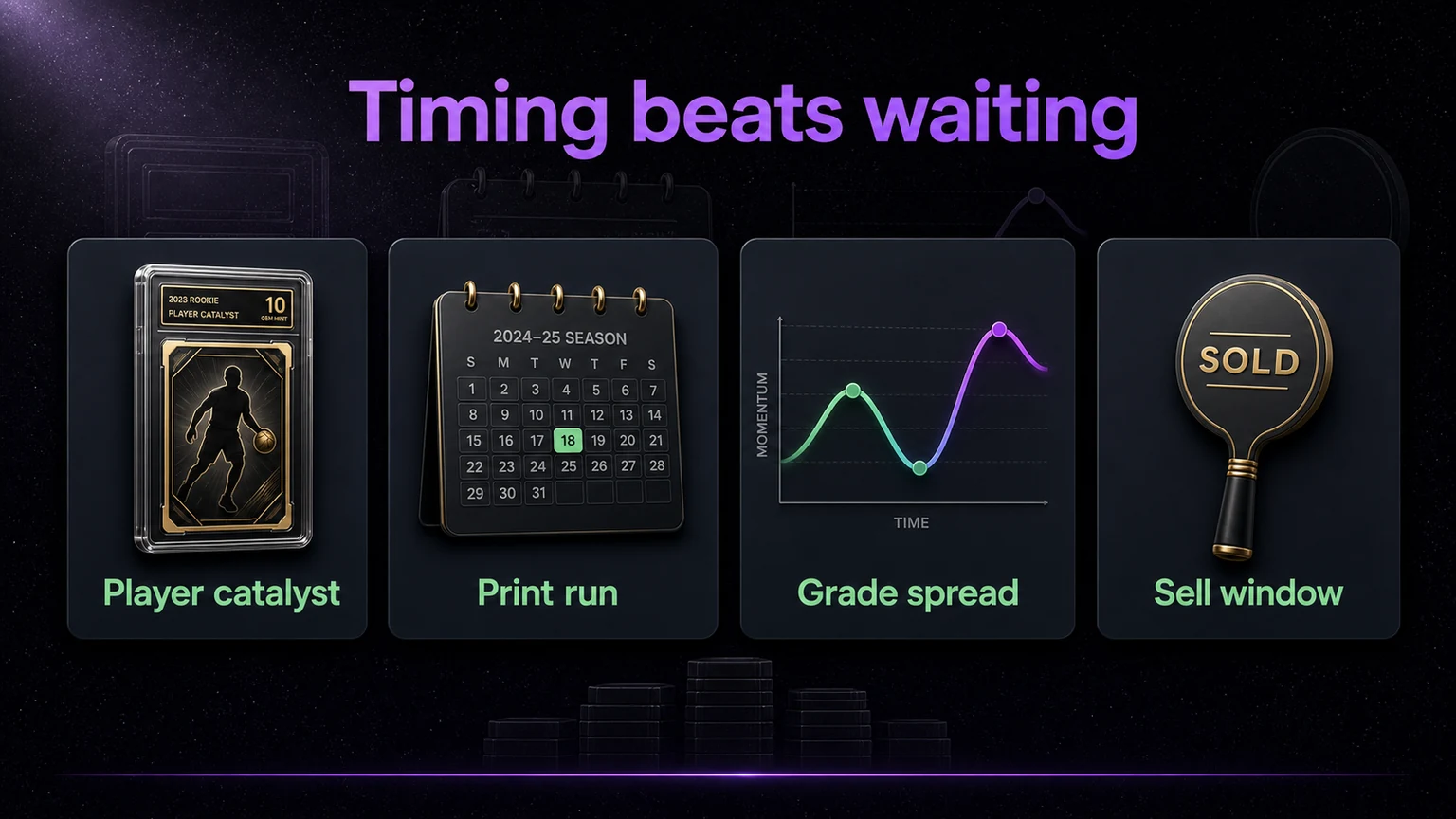
You bought the rookie. You did what every YouTube guru told you. You slid it into a top loader, put it in a box, and waited for the money printer to warm up.
Two years later you pull it out. The kid got hurt. Or he got benched. Or he was fine, but so was every other collector who bought forty copies of the same base card, and now the market is drowning in them. Your $40 rookie is worth $18. You paid retail, you sat on it blind, and the market moved without you.
That is the tax on the biggest lie in this hobby: "buy rookies and wait." It sounds like investing. It is closer to buying a lottery ticket and framing it.
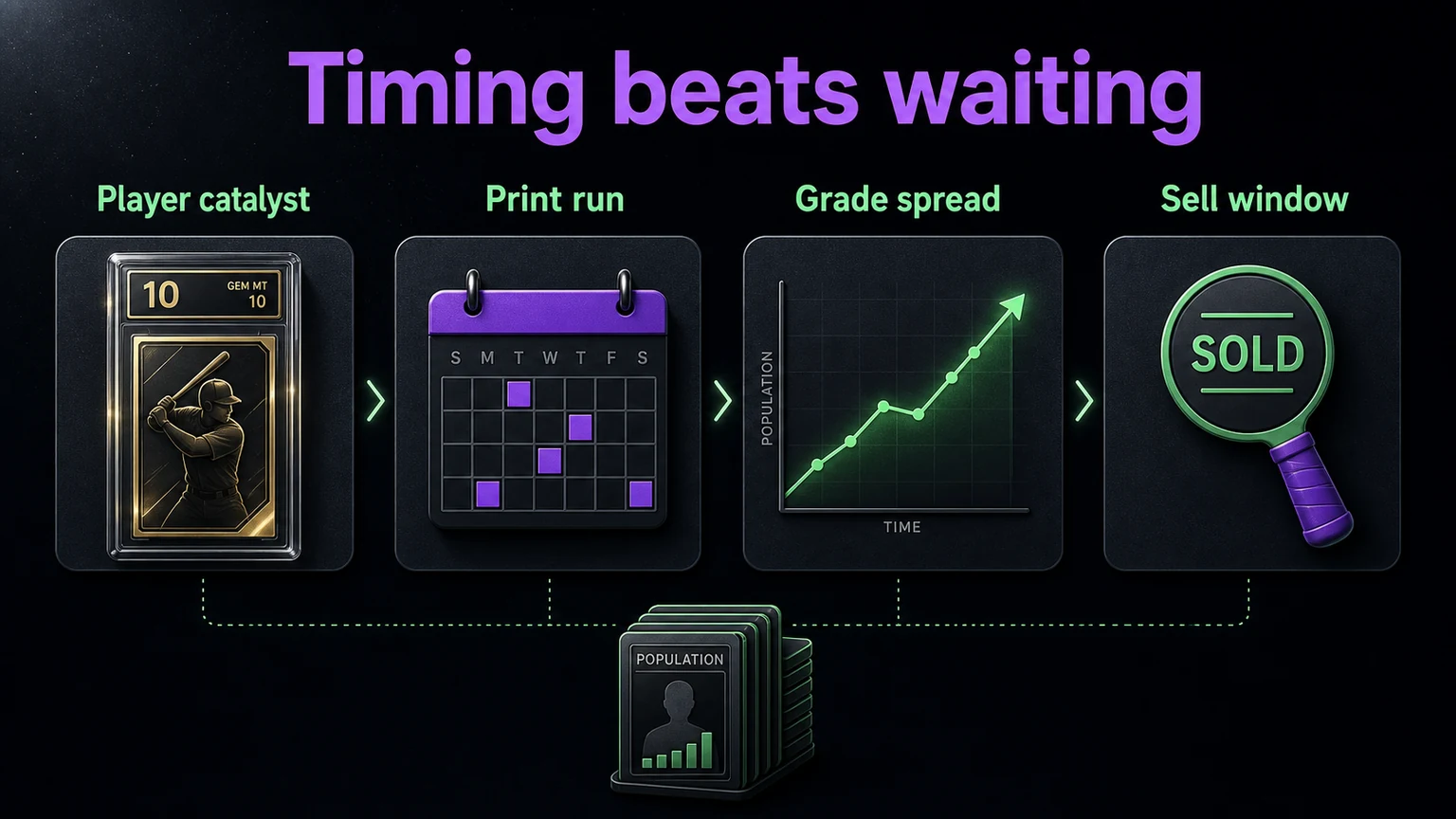
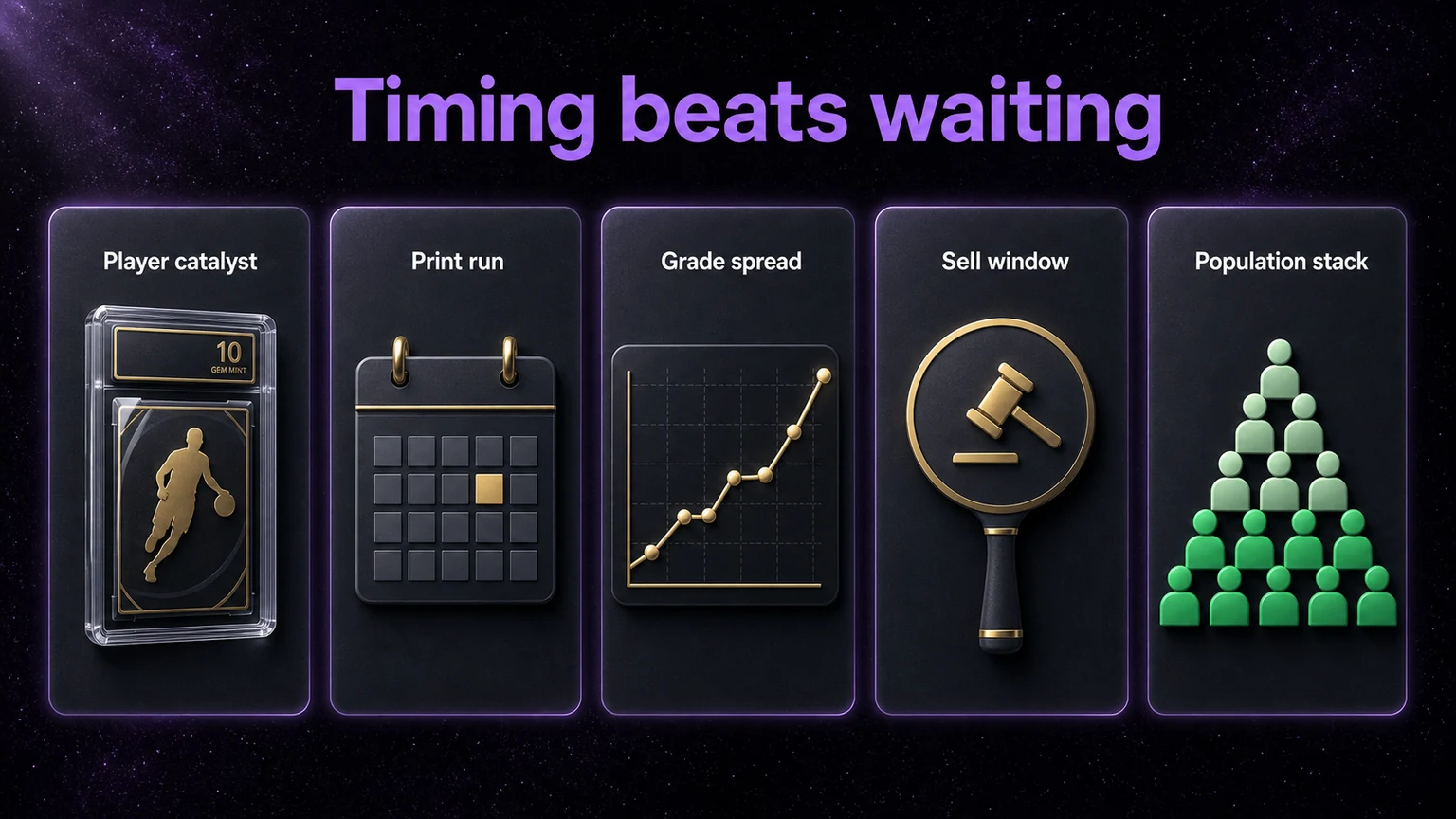
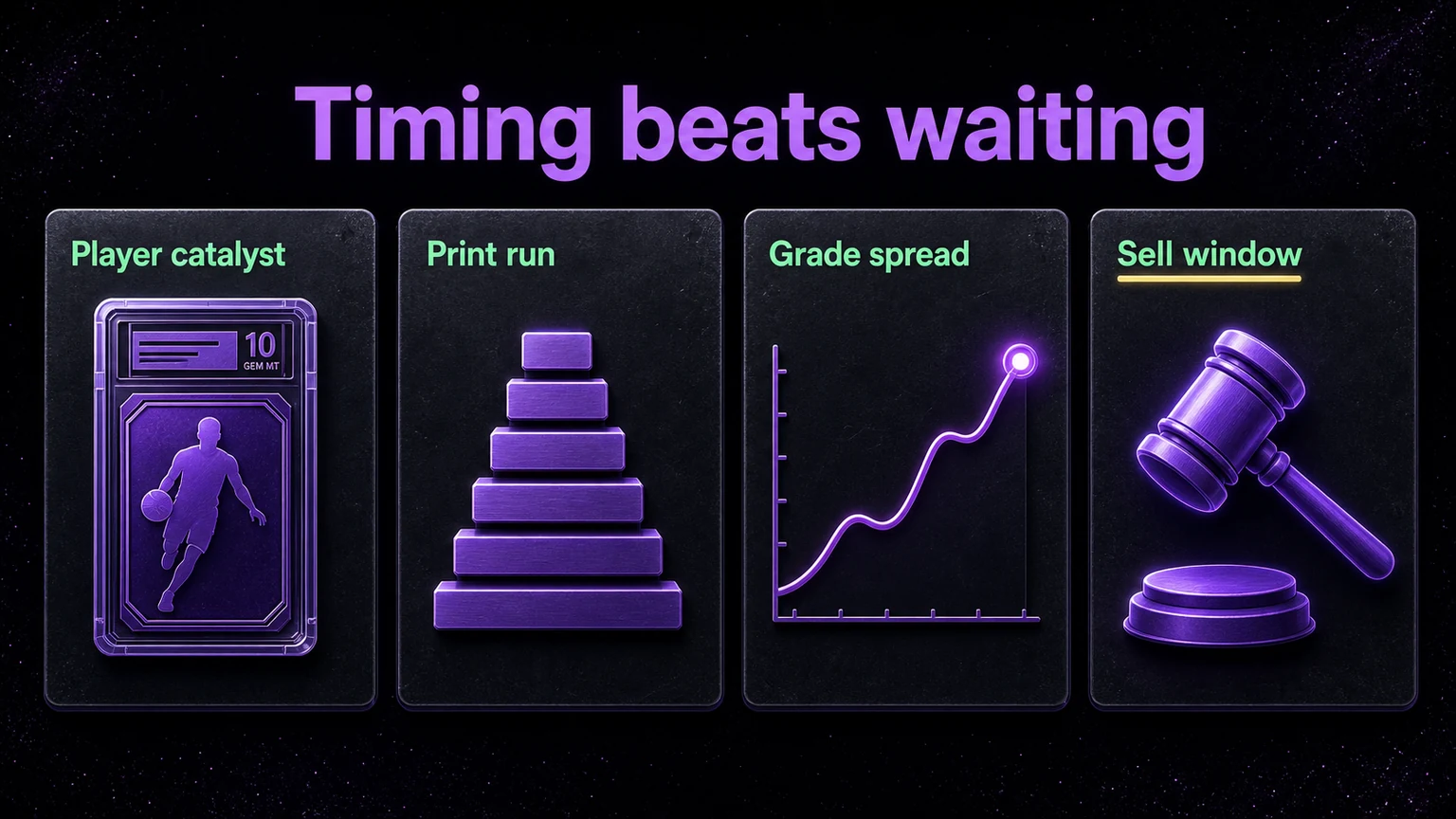
Here is the fix, in one line. A sports card's price is driven by three engines running at once: player performance, print scarcity, and grade. And a fourth thing decides whether you keep any of the gain: timing. Miss the timing and the best card in the world still loses you money. This guide breaks down all four, with real math, so you stop praying and start reading the board.
The lie: rookies go up if you just wait
"Buy rookies and wait" survives because it is easy to say and impossible to disprove fast. You buy a card. Nothing happens for a year. Nobody blames the strategy, because the strategy was to wait, and you are still waiting.
Meanwhile three things quietly eat you alive.
The player is a coin flip. Most rookies do not become stars. They become depth guys, journeymen, or a name you forget. The hobby only pays for a small handful of players per draft class, and you do not know which ones on card-buying day. That is not investing. That is scouting, and pro scouts with millions of dollars and film rooms get it wrong constantly.
The print run is not scarce. Modern flagship base rookies are printed in enormous quantities. Topps, Panini, and the rest run the presses to meet demand, and demand at release is high. A base rookie of a hyped prospect can exist in the hundreds of thousands. Scarcity is what makes a card go up. A card that anyone can buy any day is not scarce, no matter how good the player gets.
The supply keeps growing after you buy. This is the part "wait" never mentions. Population reports only go up. Every week more copies get graded and hit the market. A card that had 50 PSA 10s at release can sit at 5,000 a year later. You waited for scarcity, and the hobby manufactured the opposite.
So "buy and wait" quietly bets on the one player who breaks out AND stays healthy AND had a low enough print run to stay scarce, and then asks you to guess the exit. That is four correct calls stacked on top of each other. Waiting does not make those calls for you. It just delays the moment you find out you were wrong.
The enemy here is not you for buying a rookie. The enemy is the guru who sold you a one-word plan and a dream, and the reflex to pay retail and sit blind while the print run and the population report work against you.
Engine one: player performance moves the market in hours
Card markets are thin. There are not that many active buyers for any single card at any moment, so new information hits the price like a hammer. A playoff run, a breakout game, an award, a trade, an injury. The player did not change overnight. The spotlight did, and thin liquidity does the rest.
Real 2025 example of the up move. A rookie pitcher went out in the postseason and threw 5.1 no-hit innings with 11 strikeouts against the Yankees. His card market ran from around $80 to north of $160 in the days after. One start. Roughly double.
Real 2025 example of the down move. A rookie quarterback started hot, then took a rib injury. His PSA 10 premium parallels got cut by roughly half, sliding to around $810 from playoff highs. Same card. Same player. One injury.
That is the engine. It cuts both ways, and it cuts fast. Which is exactly why "wait" is dangerous: waiting means you are holding through both the up moves and the down moves, hoping to be holding on a good day. Playoff appearances do carry measurable long-term weight, rookie cards from players who reach the playoffs in year one have historically appreciated meaningfully more than those who do not, but you still have to survive the volatility to collect it.
The takeaway is not "predict the future." It is "be positioned before the catalyst and be ready to move when it hits." Draft night, debuts, award announcements, playoff runs. Those are known dates on a calendar. You can be early to them if you know they are coming, which is the entire point of running alerts instead of refreshing a page and hoping.
Engine two: print scarcity is the whole game
Two cards. Same player. Same rookie season. One sells for $30, one sells for $3,000. The difference is not the athlete. It is how many exist.
Modern sports products are built as scarcity ladders. At the bottom sits the base rookie, printed in bulk. Above it sit the parallels: colored versions, refractors and prizms, and serial-numbered cards stamped like "23/99" or "1/10." A card numbered to 99 means 99 copies exist on the planet, full stop. A one-of-one means exactly one. As you climb that ladder, supply collapses and price explodes, even though the picture on the front barely changes.
This is why "any rookie card of a star goes up" is only half true. The star's base card is fighting a flood of supply. The star's numbered parallel is fighting nothing, because there are only a handful, and rich collectors will pay for the rarest one.
Two rules that fall out of this:
Read the number before you buy. A base card and a card numbered to 25 are different investments wearing the same face. Pay base-card prices for base cards and understand that the ceiling is capped by supply.
Watch population velocity, not just the population. A pop report is a snapshot. What matters is how fast the number is climbing. If a card is getting graded 500 times a month, its scarcity premium is evaporating in real time while you "wait." If a vintage or short-printed card adds two copies a year, scarcity is on your side. The single most common beginner mistake is reading the total population once and never checking how fast it grows.
Scarcity only pays when demand shows up too. A card numbered to 10 of a player nobody wants is a card numbered to 10 that nobody wants. Low supply times real demand is where the money lives. Low supply times no demand is just an expensive way to own cardboard.
Engine three: the grade, and the raw vs PSA 10 gap
Here is the number that reframes this entire hobby.
For modern rookie cards, a PSA 10, the top grade, commonly sells for roughly 4x to 8x the raw ungraded price of the same card. Same card. Same player. Same print run. The only difference is a plastic case and a number that says "gem mint."
For high-grade vintage, the gap gets absurd. PSA 10 examples of old cards can sell for 10 to 50 times the raw price, and grade-to-grade cliffs of a PSA 9 at $80 versus a PSA 10 at $4,500 exist and are not even rare. That is a 56x jump between two grades that a normal human eye often cannot tell apart.
Why does the gap exist? Scarcity again, but scarcity of condition. PSA grades roughly 90% of modern submissions at PSA 8 or higher, but only around 2% to 5% of modern cards come back as a PSA 10. The other 95%-plus have a flaw, a soft corner, a print line, a micro-scratch under the foil, something that holds them back. The PSA 10 is the rare one, and the market pays for rare.
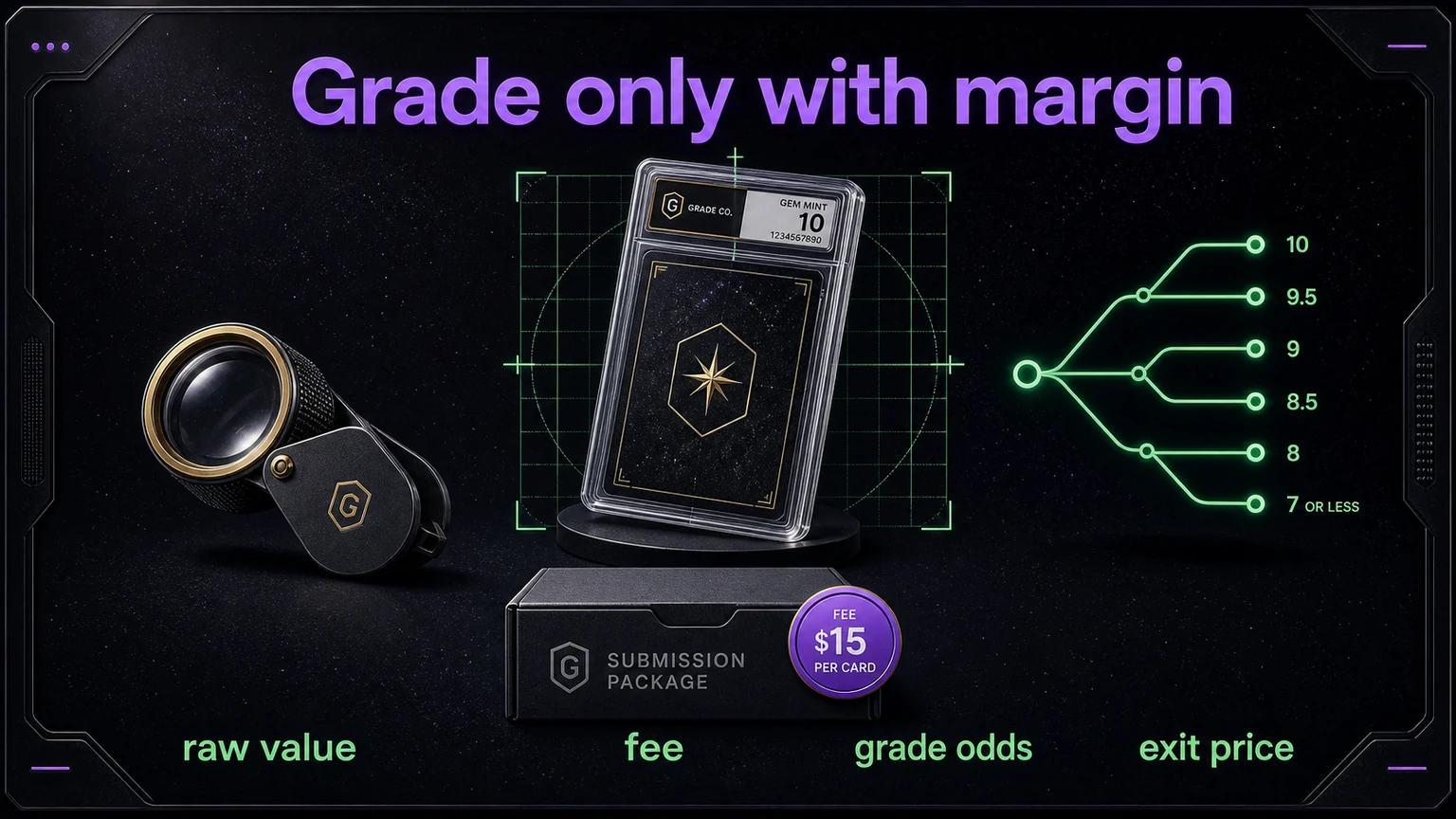
Now the trap that "buy and wait" walks you straight into. Grading only pays if you actually hit the 10. On modern cards, a PSA 9 often sells at or barely above raw once you subtract the grading fee. You can pay to grade a card and come out behind. The premium lives almost entirely at the 10, and the 10 is the copy you probably do not have.
So the raw vs PSA 10 gap is not free money. It is a bet on condition, priced by a company, with a fee attached. Let us do the math on that bet.
Worked example: the raw-to-PSA-10 math, honestly
Say you own a hyped rookie. Raw copies sell for $60. A PSA 10 of the same card sells for $300. That is a 5x gap, right in the normal modern range. Feels like a layup. Grade it, quintuple your money.
Watch what actually happens after costs. We will use round, checkable numbers.
| Line item | PSA 10 outcome | PSA 9 outcome |
|---|---|---|
| Sale price (graded) | $300 | $85 |
| Grading fee (per card, open tier) | -$25 | -$25 |
| Shipping to grader + supplies | -$8 | -$8 |
| Shipping to buyer | -$6 | -$6 |
| eBay final value fee (~13.25% + $0.40) | -$40.15 | -$11.66 |
| Your cost to buy the raw card | -$60 | -$60 |
| Net profit | +$160.85 | -$25.66 |
The PSA 10 nets about $161 on a $60 card. Real money. But the PSA 9 loses you about $26 on the exact same card, because a modern PSA 9 barely clears raw and the fees finish the job.
Now weight it by reality. If this card gems at, say, a 30% rate (optimistic for a raw card you did not pre-screen hard), your expected value per submission is roughly (0.30 x $161) plus (0.70 x -$26), which is about $48 in the plus column, before you value your own time. Positive, but a fraction of the $240 "5x gap" the sticker promised. And that math flips negative fast if your gem rate is lower, your card is cheaper, or the raw-to-10 spread is tighter.
The rule that falls out: the raw-to-PSA-10 spread has to clear all your costs with room to spare, ideally the graded price is a couple times your all-in cost basis, and cards under about $50 raw rarely make financial sense to grade at all because the fee eats the premium. "Buy rookies and wait" never runs this math. It just assumes the top-grade price is your price. It almost never is.
If sifting gem candidates, tracking spreads, and timing catalysts sounds like a real job, that is because it is one. This is where a card community earns its keep. The Divine Cards Pass exists to point at winning cards early and flag the moves before the crowd, so you are reading the board instead of guessing at it.
Engine four: timing decides whether you keep the gain
You can nail the player, the print run, and the grade, and still lose, because you sold on the wrong day. Timing is not a tiebreaker. It is a fourth engine.
The counterintuitive rule the market keeps proving: sell into the spike, not after it. The highest rookie prices of the year often print in the 48 hours after draft night, before the player has thrown a single pass. Debut spikes and summer-league hype fade 30% to 50% within about two weeks. Basketball tends to peak during the April to May playoff hype, not during the Finals when everyone is finally paying attention. By the time a move is obvious on the evening news, the smart exit already happened.
Because nobody catches the exact top, the pros ladder out. They do not dump 100% at once and they do not hold 100% forever. A common approach: sell a chunk at plus-50%, another chunk at plus-100%, another into a major catalyst like a playoff run or an award, and keep a small piece for the long-term lottery. You lock in real profit, you keep some upside, and you stop torturing yourself trying to sell the literal peak.
Signals that a peak is near: mainstream media finally covering the player, grading submissions spiking (more supply incoming), and eBay sold prices flattening for two-plus weeks. When the crowd arrives and the sold comps stop climbing, that is the tap on the shoulder.
"Wait" has no exit plan. That is its fatal flaw. It buys, it holds, and it hopes the phone rings on a good day. Timing is a decision, and decisions beat hope.
The villains, named
Point the frustration where it belongs.
Paying retail and sitting blind. Buying a base rookie at hype-peak prices and waiting while the print run and pop report bury you.
The one-word guru. The Lambo account selling "buy and hold" with no talk of print runs, fees, gem rates, or exits, because a plan that simple was never meant to make you money. It was meant to make you a follower.
Slow information. The card market moves in hours. If your news source is a highlight that already trended, you are buying the top other people are selling into.
Grading blind. Submitting cards you never pre-screened under a bright light, paying the fee, and getting a rack of PSA 9s that sell at raw.
None of those villains is you for wanting in. They are just the specific ways this hobby separates casual buyers from their cash, and every one of them is beatable with better information and a little discipline.
Who should skip this
Sports card investing is not for everyone, and pretending otherwise is how people get hurt.
Skip it if you need the money soon. This is illiquid. Cards can sit for weeks, values swing on injuries, and a "worth $300" card is only worth what someone pays this week.
Skip it if you will not do comps. If checking recent sold prices, print runs, and population reports before every buy sounds like a chore, this will cost you money. The entire edge is in that homework.
Skip it if volatility wrecks you. A rib injury can halve your card overnight. If watching that happen would make you sell in a panic, protect your peace and pick a calmer game.
Skip it if you thought this was passive. It is a hobby-business with fees, taxes, unsold inventory, and time cost. Fun, yes. Passive, no.
If that list did not scare you off, you probably have the temperament for it. The rest is information and speed, both of which you can get. For the wider retail side of the same skill set, the flagship Divine community on Whop runs alerts across sneakers, cards, and clearance flips, and Divine offers a 5-day free trial so you can audit the alert speed before you pay for a month.
FAQ
Is buying rookie cards a good investment?
Sometimes, but not the way it is usually sold. A rookie card is only a good investment when the player produces, the specific card is genuinely scarce (a low print run or numbered parallel, not a bulk base card), and you buy at a sane price with an exit plan. Buying a hyped base rookie at peak and waiting is the version that loses money. Read the print run and the comps first.
What is the price difference between a raw card and a PSA 10?
For modern rookies, a PSA 10 commonly sells for roughly 4x to 8x the raw price of the same card. For high-grade vintage the gap can run 10x to 50x. The catch is that only about 2% to 5% of modern cards grade a PSA 10, and a PSA 9 often sells near raw once you subtract fees, so the huge gap is really a bet on condition, not a guarantee.
When should I sell a sports card?
Sell into strength, not after it. The best windows are usually the spike itself: draft night, a debut, an award announcement, or a playoff run. Prices often fade 30% to 50% within two weeks of a debut spike, and markets frequently peak during playoff hype rather than the Finals. Because nobody times the exact top, laddering out in stages beats holding for one perfect day.
How much are eBay fees on trading cards?
For most sellers, eBay's final value fee on trading cards runs about 13.25% of the total (item price plus shipping plus any tax eBay collects), plus roughly $0.30 to $0.40 per order, up to $7,500 per item. That fee comes off the top of every sale, so it has to be in your math before you buy, not after you sell.
Should I grade my sports cards?
Only when the raw-to-PSA-10 spread clears all your costs with room to spare, and only on cards you have pre-screened hard for a real shot at a 10. Grading fees, shipping, and supplies add up, and a PSA 9 on a modern card often sells at or below raw. As a rough floor, cards worth under about $50 raw rarely justify grading. See our PSA grading guide for the full cost-versus-premium math.
Are sports cards or Pokemon cards a better flip?
They break differently. Sports card value hinges on a living athlete's performance, which adds a fast, brutal catalyst engine that Pokemon does not have. Pokemon leans more on sealed product and set scarcity. Neither is automatically better. If you want the comparison, read our Pokemon card investing guide alongside this one.
Verdict: read the board, do not just wait
"Buy rookies and wait" is not a strategy. It is the absence of one. It skips the player risk, ignores the print run, assumes the top grade is your price, and has no exit.
The real game runs on four engines. Player performance moves prices in hours. Print scarcity sets the ceiling. Grade sets the multiplier, and the raw-to-PSA-10 gap is a fee-loaded bet on condition, not free money. Timing decides whether you keep any of it. Get those right, run the math after fees, and sports cards can be a genuine business. Get them wrong and it is an expensive shoebox.
The fastest way to get them right is better information and more speed than the person on the other side of the trade. That is what a real card community sells: early reads, monitor coverage, and honest calls. Start with the Divine Cards Pass if cards are your lane, or the broader Divine reselling community if you want the sneakers and clearance flips too. For the money side, our reselling profit margins guide and flipping taxes and fees breakdown are the next reads.
Realistic expectations: sports card investing is a business with real costs and real risk. Marketplace fees, grading fees, shipping, taxes, unsold inventory, and market swings all eat into returns, and profits are never guaranteed. Cards can drop as fast as they rise. Always check recent sold comps and population data before you buy, and never risk money you cannot afford to lose.
Get to the deal first
Divine is the alert network, monitors, and autocheckout built on this exact process. Try Divine Pro free for 5 days.
Reselling is a real business with real costs: marketplace fees, shipping, taxes, and unsold inventory. Profits are never guaranteed. Always check the comps before you buy.